

Have you ever heard the term low-level laser therapy? It's a method that uses very specific wavelengths of light to give your body's cells a helping hand. The goal is to gently energize them, which can help reduce inflammation and kickstart your natural healing and regeneration processes, all without using heat or damaging any tissue.
Understanding Low Level Light Therapy
Think of it this way: a plant uses sunlight to create energy and thrive through photosynthesis. Low-level light therapy (LLLT) works on a surprisingly similar idea, but for our own cells. Instead of sunlight, it uses precise red and near-infrared light to essentially "feed" our cellular powerhouses, helping them work more efficiently.
This entire process has a more technical name: photobiomodulation. It sounds complicated, but it breaks down quite logically:
- Photo: From the Greek for "light."
- Bio: Meaning "life" or living tissue.
- Modulation: Which just means to regulate or influence.
So, photobiomodulation is simply using light to influence biological processes. It's like speaking to your cells in a language they already know and understand—the language of light energy.
To make this even clearer, here's a quick rundown of the core concepts.
Photobiomodulation At A Glance
| Concept | Simple Explanation |
|---|---|
| The Goal | To stimulate cellular activity and support the body's natural repair mechanisms. |
| The "Fuel" | Specific wavelengths of red and near-infrared light (typically 630-850 nm). |
| The Mechanism | Light energy is absorbed by mitochondria, the "power plants" inside your cells. |
| The Result | Increased cellular energy (ATP production), improved circulation, and reduced inflammation. |
Ultimately, it’s about giving your cells the right kind of energy so they can do their jobs better.
Light Source The Key to Effective Therapy
Now, when most people hear the phrase "low-level laser therapy," they get hung up on the word laser. But here’s a common misconception: the laser is just the delivery system. The therapeutic power doesn't come from the device itself, but from the quality of the light it emits.
For this therapy to work, what really matters are the wavelength (the specific color of the light) and the energy density (how much light reaches the tissue). This is where technology has made huge strides. Today, high-quality Light Emitting Diodes (LEDs) can be engineered to produce the exact, clinically-proven wavelengths needed for effective photobiomodulation.
The therapeutic effect comes from the light itself—specifically, its color (wavelength) and intensity. Whether that light is delivered by a laser or a high-quality LED, the goal is the same: to deliver the right dose of light energy to the cells.
Building the Foundation for Wellness
By giving cells this energy boost, LLLT helps create the perfect environment for your body to function at its peak. It bolsters the fundamental processes that are crucial for everything from skin health to supporting a healthy scalp. For instance, better cellular energy promotes improved blood flow, which in turn brings more oxygen and vital nutrients to tissues like your hair follicles.
This is what makes photobiomodulation such a promising approach. It isn’t a quick fix that just masks symptoms; it’s about supporting your body’s built-in capacity to repair and rejuvenate itself. And thanks to modern, accessible LED technology, you no longer need to visit a pricey clinic to benefit. You can now bring this science-backed practice right into your home and make it part of your daily routine.
How Light Therapy Recharges Your Cellular Batteries
To really get what’s happening with light therapy, we have to look at what’s going on inside your body at a microscopic level. It turns out that specific kinds of light can act like a key, unlocking your cells' natural ability to heal and energize themselves.
Imagine the trillions of cells in your body each have their own tiny, rechargeable power packs. These are called mitochondria, and their main job is to produce the energy that fuels everything you do—from thinking and moving to healing and growing new hair.
This cellular energy comes in the form of a molecule called adenosine triphosphate (ATP). When your cells are running low on ATP, they just can't perform at their best. That’s where photobiomodulation, or light therapy, steps in.
Fueling Your Cells with Light
Certain wavelengths of light, especially red and near-infrared, are perfectly tuned to be absorbed by a specific component inside our mitochondria called cytochrome c oxidase. When photons from these light sources hit this receptor, it's like plugging your cellular batteries directly into a charger.
This jolt of light energy stimulates the mitochondria to kick into high gear and produce more ATP. With plenty of ATP on hand, your cells have the fuel they need to operate at their peak. It’s a fundamental boost that starts a chain reaction of positive effects throughout the body.
Here’s the thing: Light therapy doesn't add anything foreign to your system. It simply provides the specific light energy your cells are already built to receive, helping them create the ATP they need to function at their best.
The whole process is a lot like how a solar panel works. The panel soaks up sunlight and converts it into electricity. In the same way, your cells absorb specific wavelengths of light and turn that light energy into usable cellular energy.
This diagram helps show that simple, powerful flow from light source to cellular benefit.
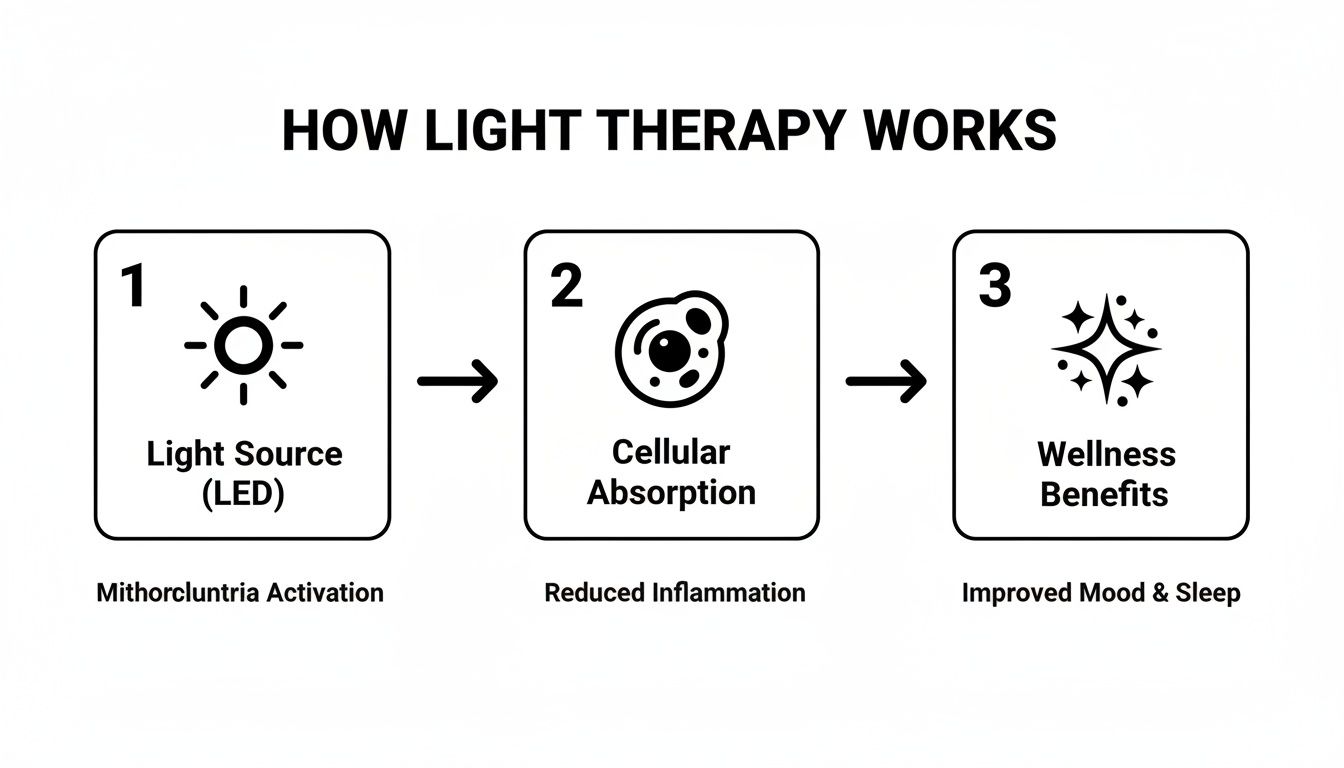
As you can see, it all starts with a quality light source, like an LED. The photons travel to the cells, get absorbed, and help enhance your body's own wellness processes.
The Powerhouse Duo of Light Wavelengths
The effectiveness of photobiomodulation hinges on using the right wavelengths. After decades of research, two specific ranges have proven to be the most biologically active:
- Red Light (around 660nm): This wavelength is fantastic at penetrating the skin and is mostly absorbed in the more superficial layers of tissue. It's well-known for boosting skin health and tackling surface-level issues.
- Near-Infrared Light (around 850nm): This wavelength is invisible to the naked eye and travels much deeper into the body. It can reach muscles, joints, and—crucially for us—the very base of the hair follicles.
Combining both 660nm red light and 850nm near-infrared (NIR) light gives you a powerful, dual-action treatment. This is exactly why you'll find both in modern LED devices like the Prospek cap. The red light works its magic on the scalp's surface while the NIR light gets down to the follicles and the blood vessels that feed them.
From Cellular Energy to Real-World Benefits
So, what does this big boost in cellular energy actually do for your scalp? The effects are very real and translate into benefits you can both see and feel.
- Better Blood Flow: The extra ATP helps the walls of your blood vessels relax, which improves circulation. This means more oxygen and vital nutrients get delivered straight to your hair follicles, creating a much healthier environment for growth.
- A Calmer Scalp: Light therapy has a natural soothing effect and helps manage the body's inflammatory responses. On the scalp, this can lead to less irritation and redness, giving you a calm, balanced foundation.
- Energized Cells: With more energy, your cells are simply better at their jobs—including repair and regeneration. This helps support the natural hair growth cycle right from the source.
As you can see, LED light therapy isn't a forceful intervention; it’s a supportive process that works with your body's natural systems. To dive even deeper, you can learn more about the specifics of this mechanism in our detailed guide on how LED light therapy works. This two-pronged approach helps you get comprehensive benefits, all without needing invasive or complicated procedures.
The Evolution of Light Therapy From Lab to Living Room
Light therapy isn’t some new wellness trend that just popped up. It’s a well-established science with a fascinating history that stretches back decades, starting with a complete accident in a research lab and ending with the sophisticated devices we can use in our own homes today. Understanding this journey shows just how far the science has come.
It all began, rather unexpectedly, back in 1967. A Hungarian physician named Endre Mester was running experiments with early lasers when he noticed something strange. A low-powered laser beam, which wasn't strong enough to cut or burn, seemed to dramatically speed up wound healing on his test subjects. He had stumbled upon the biological effects of light, and this discovery was the birth of what we now call photobiomodulation, or Low-Level Laser Therapy (LLLT). If you’re a history buff, you can explore the origins of LLLT and its clinical journey to see how it all started.
From Bulky Machines to Pocket-Sized Power
For a long time, if you wanted light therapy, you had one option: go to a clinic. The original equipment was massive, expensive, and could only be operated by a trained professional. These were not machines you could just buy and take home.
Over the following decades, thousands of studies were published as scientists dug deeper into how light worked on a cellular level. They meticulously identified the specific wavelengths that produced the most powerful biological response. As the science matured, the technology started to catch up.
The Rise of High-Performance LEDs
The real game-changer was the development of Light Emitting Diodes (LEDs). Early LEDs were weak, like the little indicator lights on a stereo, and couldn't produce the kind of focused, powerful light needed for therapy. But technology advanced at an incredible pace.
Today’s high-performance LEDs are a world apart. They can be engineered to emit very specific, narrow bands of light—like the clinically proven 660nm red light and 850nm near-infrared light—with remarkable precision and power.
Here’s what really matters: The therapeutic magic comes from the specific wavelength and energy of the light itself, not whether the source is a laser or an LED. Modern LEDs can deliver the exact same beneficial light as the old clinical lasers, just far more efficiently.
This breakthrough is what brought light therapy out of the clinic and into our homes. What once required a machine the size of a refrigerator could now be accomplished with a handful of tiny, cool-to-the-touch diodes. This innovation allowed for the creation of safe, affordable, and incredibly effective at-home devices. Suddenly, manufacturers could design products like caps and panels that provide broad, even coverage, something a single laser point always struggled with. For a deeper dive into how different devices work, you can check out our guide on red LED panels.
All of this brings us to today. A device like the Prospek cap is the direct result of over 50 years of scientific research and technological refinement. All that power, history, and science is now packed into a comfortable cap that runs on a simple rechargeable battery. It's an incredible journey from a lab accident to a practical tool for scalp wellness in your living room.
The Science Behind Light Therapy for Scalp and Hair Wellness
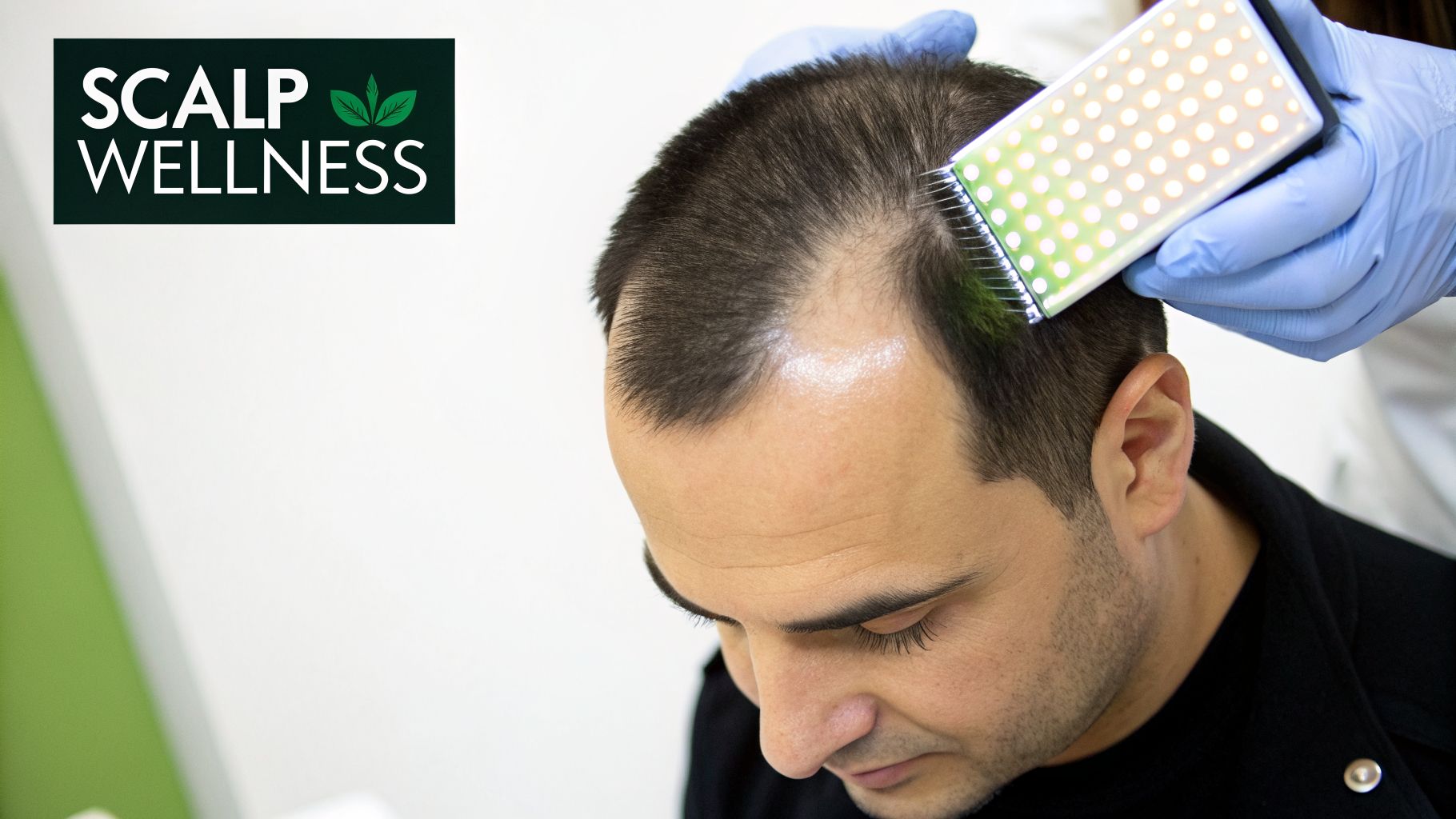
While the idea of using light to "recharge" your cells is fascinating, it’s most powerful when you see how it applies to a real-world goal, like getting healthier hair. The secret to strong, full hair isn't in a special shampoo—it’s in the biology of your scalp. This is exactly where low-level laser therapy (LLLT), also called photobiomodulation, comes into play.
Think of it like tending a garden. You can’t expect healthy plants without first preparing the soil. In the same way, light therapy helps create the perfect conditions for your hair follicles to do their job. It's not a magic fix; it's a way of giving your body's natural systems the support they need to work at their best.
By sending gentle red and near-infrared light to the scalp, we can help foster a calm, well-fed environment where your hair's growth cycles can run smoothly, just as they're meant to.
Creating an Optimal Scalp Environment
So, how does this actually help your hair? Two of the biggest wins from light therapy are better circulation and less irritation. When your cells get a boost of energy from the light, the tiny blood vessels in your scalp start to relax and open up.
This is a huge deal for your scalp. Better blood flow means more oxygen and nutrients can get delivered right to the root of each hair follicle. Follicles are like tiny factories, and they need a constant supply of resources to build strong, healthy hair. Light therapy clears the supply lines, making sure they get everything they need.
At the same time, this therapy has a well-known calming effect. By helping to dial down the body's inflammatory signals, it can soothe the itchiness and redness that often come with a stressed scalp. A calm scalp is a happy scalp—and it’s much better at growing healthy hair.
Light therapy helps create an ideal foundation for hair wellness by improving nutrient delivery and promoting a calm, balanced scalp environment. It supports your body's natural processes, rather than forcing an outcome.
What the Evidence Shows
It’s reassuring to know that the science behind light therapy is solid and has been proven in many areas beyond hair and scalp health. For years, clinicians have used LLLT to help with tissue healing and pain management for a whole host of issues. In fact, success rates for pain management often land between 50-75%, depending on the specific condition.
For instance, a major 2017 analysis concluded that LLLT is an effective way to reduce pain in adults dealing with musculoskeletal problems. The sessions themselves are usually quick, often taking just a few minutes. You can get a good feel for the broader clinical picture by reading this overview of how low-level laser therapy works.
This proven ability to calm tissues and speed up healing is directly applicable to the scalp, where even low-grade, chronic irritation can throw the hair growth cycle out of whack.
Setting Realistic Expectations for Your Journey
Understanding the science is also key to setting the right expectations. Light therapy works with your body's natural rhythms, which means results aren't going to show up overnight. It's all about consistency and patience.
Here’s a general timeline of what you can realistically expect when using an at-home LED device for your scalp:
- First 1-2 Months: The first changes are usually things you feel, not see. Many people mention their scalp feels calmer, less itchy, or less oily. This is the crucial groundwork being laid at the cellular level.
- Months 3-6: With regular use, you might start noticing real, visible changes in your hair. Because the hair growth cycle is a slow process, it takes time for those healthier, re-energized follicles to produce new hair that you can actually see and feel.
- Months 6+: This is when the full benefits of your routine really start to shine. Sticking with it helps maintain that healthy scalp environment you've worked so hard to build.
Without a doubt, consistency is the most important part of getting results. Sticking to a schedule of a few sessions a week is what allows these positive cellular changes to compound over time. To take a deeper dive, you can explore our article on using red light therapy for hair loss. When you understand the process, you can feel confident in your routine and stay committed long enough to see a real difference.
Why Modern LED Devices Are a Game Changer
When people first explore what is low level laser therapy, the word "laser" itself often creates a bit of confusion. It's easy to assume that a laser is the only—or even the best—way to deliver this kind of light. Let's clear that up. The therapeutic effect doesn't come from the device itself, but from the specific properties of the light it produces: its wavelength and energy.
Put simply, your cells don't care if the light comes from a laser or an LED. They just respond to specific wavelengths. The real question is whether a device can deliver the right kind of light safely and effectively. This is where modern LED technology has completely rewritten the rulebook for at-home treatment.
Today’s high-quality Light Emitting Diodes (LEDs) are engineered with incredible precision. They can produce the exact red and near-infrared wavelengths proven effective in decades of clinical studies, offering the same benefits once reserved for huge, costly machines in a dermatologist's office.
The Power of Wavelength and Coverage
One of the biggest practical advantages of LEDs is their ability to cover a large area evenly. Imagine trying to treat your scalp for hair thinning. A laser delivers a single, pinpoint beam of light, which would be like trying to water your entire lawn with a squirt gun. It's just not practical for covering the thousands of follicles across your head.
An LED device like the Prospek cap, on the other hand, is built with an array of hundreds of individual diodes. This design bathes your entire scalp in uniform, therapeutic light all at once. This total coverage is what helps create a healthy and consistent environment for all your hair follicles, not just the few you might hit with a laser beam.
For home use, this widespread application is simply a more efficient and logical approach. It ensures no spot is missed.
Unmatched Safety and Convenience for Home Use
While clinical-grade lasers are powerful, they need a trained professional at the controls to be used safely. At-home LED devices, however, were designed from the ground up with user safety as the top priority.
- No Heat or Tissue Damage: The LEDs in a high-quality consumer device are "cold" light sources. They produce powerful light without generating heat, meaning there is zero risk of burning or harming your skin. This makes them exceptionally safe for direct, regular contact with your scalp.
- Built-in Safeguards: Reputable devices always include features like automatic timers. This ensures you get the perfect dose every single time without any guesswork, removing any risk of over- or under-treatment.
This impressive safety profile goes hand-in-hand with incredible convenience. With portable, battery-powered LED caps, you can fit a treatment session into your day effortlessly. You’re no longer tied to clinic appointments; you can get your session done while reading, catching up on emails, or just relaxing on the couch.
The single most important factor for success with light therapy is consistency. Modern LED devices remove the major barriers—cost, travel, and scheduling—that get in the way of a regular routine.
The soaring popularity of these devices is clear in market trends. Demand for LLLT has grown enormously, with North America now accounting for over 38% of the market's revenue. This growth is driven by people looking for effective, non-invasive solutions they can use themselves. You can read the full research about the growth of the LLLT market to see just how widespread this technology has become.
Ultimately, choosing a modern, high-quality LED device isn't a compromise. It's a smarter, more practical decision that puts a powerful, cost-effective tool in your hands, giving you the freedom to manage your hair health on your own terms.
Common Questions About Light Therapy for Hair
When you're looking into something like light therapy for your scalp, a lot of questions naturally come up. It's a newer technology for home use, and it's smart to want to understand it before you dive in. I get these questions all the time, so let's walk through the big ones.
My goal here is to give you clear, no-nonsense answers so you know exactly what to expect. We'll cover everything from safety to how long it really takes to see a change.
Is Low Level Light Therapy Safe for At-Home Use?
Yes, it is incredibly safe. The devices designed for home use are fundamentally different from the high-powered lasers you might find in a dermatology clinic. They use low-energy LEDs that deliver therapeutic light without any heat or dangerous UV radiation.
This means you can use them directly on your scalp without a second thought. In fact, these devices have a fantastic safety profile backed by decades of research. Most caps also have built-in timers, so they shut off automatically. This removes any guesswork and ensures you get the right dose every time.
The bottom line is this: when you use a quality LED device as directed, it’s one of the safest things you can do for your scalp health. It’s gentle, non-invasive, and you can fit it into your routine without any worry.
How Is an LED Cap Different From a Clinical Laser?
This is a great question, and it really gets to the core of how this technology became so accessible. The main differences are in coverage, focus, and sheer convenience.
Think of a clinical laser like a spotlight—it directs a single, powerful beam of light to a very specific, tiny area. An at-home LED cap, on the other hand, is like a floodlight. It's lined with hundreds of individual LEDs that bathe your entire scalp in light all at once.
But here’s the most important part: well-made LED caps are engineered to emit the exact same beneficial wavelengths used in clinics, typically 660nm red light and 850nm near-infrared light. You're getting the same foundational science, just in a format that's practical for you to use consistently at home, without the recurring costs and hassle of clinic visits.
How Long Until I See Results for My Scalp Health?
When it comes to light therapy, patience and consistency are everything. The process works by stimulating your body’s own natural cycles, and those things simply take time. You won't see a dramatic change overnight.
Here’s a realistic timeline for scalp and hair improvements:
- First 4 to 8 Weeks: The first signs are usually things you feel, not see. Many people mention their scalp feels less itchy, less oily, or just generally calmer. This is a great indicator that the therapy is creating a healthier, more balanced environment on a cellular level.
- 3 to 6 Months: This is the window where visible changes often start to appear. Hair growth is a slow, multi-stage process. As you continue your routine, you might begin to notice improvements in your hair's texture and overall appearance. Sticking with it is key—this is when your consistency really starts to pay off.
The single biggest factor for success is following the recommended treatment schedule. Just a few 15- to 20-minute sessions each week are enough for the benefits to accumulate and build on each other.
Can I Use a Light Therapy Cap With My Other Scalp Products?
Yes, you can and you should! Combining light therapy with your favorite topicals can create a really effective scalp care routine. The trick is all in the timing.
For best results, always use your light therapy device on a clean, dry scalp. This is non-negotiable. Any oils, serums, or product buildup can block the light and prevent it from reaching the cells in your hair follicles.
After your session is over, feel free to apply your go-to products like growth serums or soothing oils. In fact, the light therapy helps boost circulation in the scalp, which might even improve how well your skin absorbs these topicals. It’s like tilling the soil before you plant the seeds—you're preparing the ground for the best possible outcome.
Ready to experience the convenience and effectiveness of at-home light therapy? The Prospek cap was designed for busy lives, offering a comfortable, wire-free way to build a consistent routine. Discover how our dual-spectrum LED technology can support your scalp wellness journey.