

You notice it in ordinary moments.
A little more scalp showing under bright bathroom light. Skin that looks tired even when you slept well. A shelf full of products that ask for one more step, one more serum, one more appointment you don't have time to keep.
That’s where the idea of a wearable light therapy device starts to make sense. Not as a futuristic gadget, but as a practical answer to a simple problem. Most wellness routines fail because they ask too much from life.
If you work long hours, travel often, or just don’t want another complicated ritual, consistency becomes the bottleneck. A treatment can be promising on paper and still go unused if it ties you to a clinic chair, a wall outlet, or a rigid schedule.
Modern LED wearables change that equation. They bring light therapy into the moments you already have.
The New Era of At-Home Wellness
A few years ago, light therapy often felt like something you had to schedule around. You'd need a clinic visit, a fixed device at home, or a setup that turned a quick session into a production.
Now the category looks very different.
The person most interested in a wearable light therapy device usually isn't chasing novelty. They're trying to solve a practical problem. They want support for scalp wellness or skin care, but they also want to answer emails, make coffee, or sit on a flight without holding a device in place.
That shift isn't niche. The global red light therapy device market was valued at USD 361.5 million in 2024 and is projected to reach USD 660.8 million by 2031, according to Cognitive Market Research’s red light therapy device market report. The same report notes that demand is being driven by interest in non-invasive treatments, with North America holding the largest share, including use cases tied to scalp wellness and hair care.
Why wearables matter more than they first appear
A wearable changes the practical question from “Does this technology exist?” to “Will I use it?”
That sounds small, but it isn isn’t. A stationary device can work well in theory and still become a closet item if it only fits a perfect morning routine. A cordless cap or flexible wearable is easier to repeat because it fits around life instead of interrupting it.
Consider the difference between owning gym equipment and taking a walk after lunch. The easier option often becomes the lasting one.
Who this format fits best
Wearable light therapy tends to make the most sense for people who want:
- Less friction: no holding a panel in place during a session
- More privacy: something discreet for home, office, or travel
- Routine support: a way to make scalp or skin care feel automatic
- Non-invasive care: a tool that doesn't rely on harsh treatments or downtime
The technology matters. But for many, the bigger question is whether the design makes regular use realistic.
That’s the frame to keep in mind as you evaluate the science. Light therapy isn't just about what happens at the cellular level. It's also about whether the device makes those sessions easy enough to become a habit.
How Light Energy Rejuvenates Your Cells
The science behind light therapy sounds technical at first. It doesn't need to be.
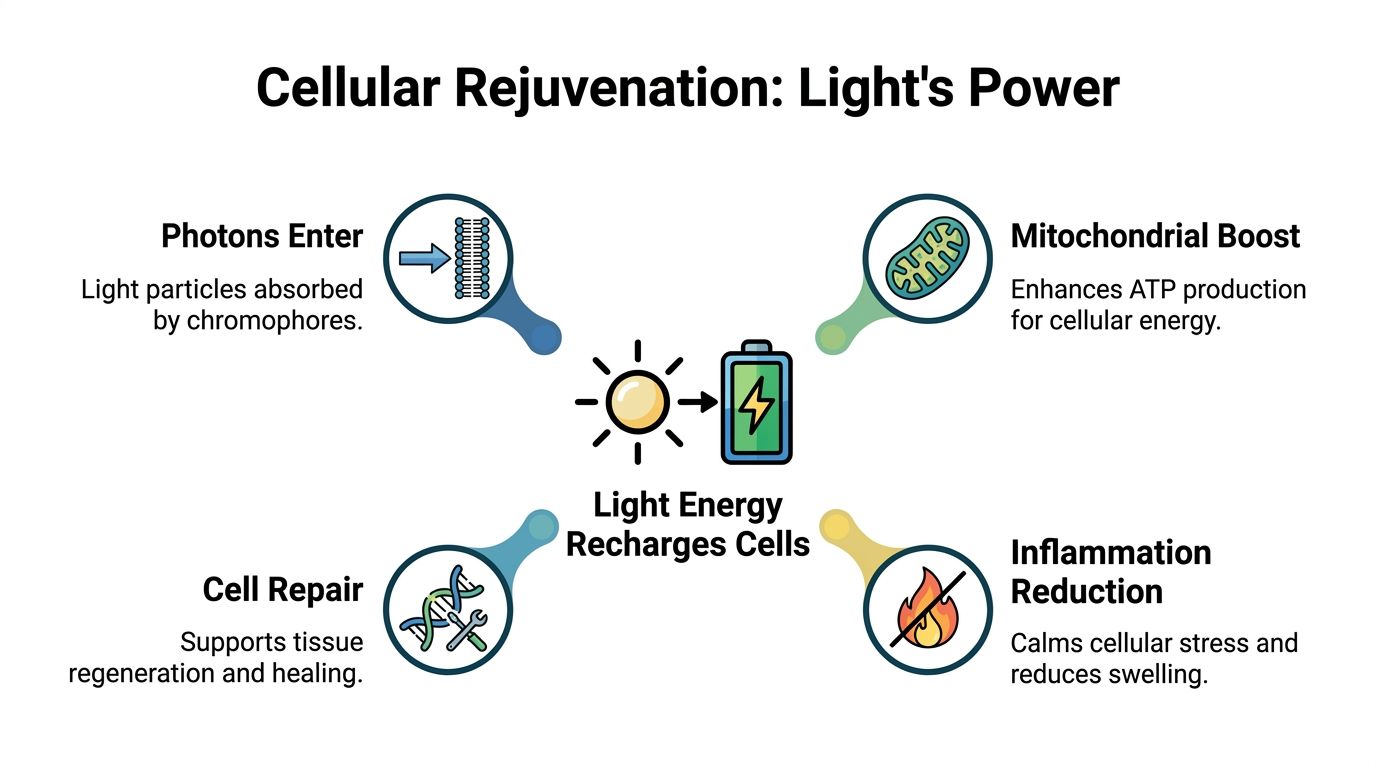
The simplest way to think about it is this. Your cells need energy to do repair work, manage stress, and maintain healthy function. LED light therapy uses specific wavelengths of light to help those cells work more efficiently.
A useful analogy is a phone battery in low-power mode. The phone still works, but some tasks feel slower and less responsive. Light therapy is less like forcing the phone to work harder and more like giving it a cleaner charge.
What photobiomodulation means in plain English
The formal term is photobiomodulation. That just means light is being used to influence biological activity.
When specific wavelengths of LED light reach tissue, cells absorb that light energy. Part of the target is the mitochondria, often described as the cell’s power centers. When they respond well, the cell can produce more usable energy, called ATP, to support normal repair and maintenance processes.
That’s why people often use light therapy for goals that sound very different on the surface, such as skin appearance, scalp wellness, and recovery support. The common theme is cellular energy and function.
Why wavelength matters
Not all light behaves the same way. In a wearable light therapy device for scalp and skin, two wavelengths matter most.
According to this review of FDA-approved red light therapy device wavelengths, 660 nm red light is useful near the surface because it’s absorbed in the epidermis and dermis, where it supports ATP production and collagen-related processes. 850 nm near-infrared light reaches deeper, penetrating 5 to 10 mm, where it can support microcirculation and healing-related activity.
That distinction clears up a common confusion.
Red light and near-infrared light are not competing options. They do different jobs.
- Red light at 660 nm: better aligned with surface-level concerns like skin texture and visible scalp condition
- Near-infrared at 850 nm: better suited for deeper tissue reach beneath the surface
- Dual-spectrum designs: useful when a device is meant to support both scalp and skin goals in the same routine
If you want a deeper primer on the basics, this explanation of how LED light therapy works gives a helpful overview without overcomplicating the science.
Why LEDs make sense for wearables
Some readers get stuck on the assumption that “stronger” must mean more aggressive technology. In practice, that’s not the right way to think about a wearable.
For a device you’ll place close to the scalp or skin, LEDs are well suited to consistent, repeatable sessions. The goal isn't to overwhelm tissue. It's to deliver the right wavelengths in a controlled, comfortable format you can use regularly.
That’s especially important for wearables because they sit close to the treatment area and are designed for routine use. Good light therapy is less about drama and more about dosage, placement, and repetition.
Surface effects and deeper effects
Here’s a simple mental model.
Think of 660 nm red light as working in the upper layers, where skin and the visible scalp live. Think of 850 nm near-infrared as reaching below that layer, where deeper support matters more.
For scalp care, that combination can be helpful because the goal usually isn't just the surface. People often want support for the environment around the follicle as well.
For skin care, the same pairing can make sense when you want both visible surface support and deeper wellness effects.
Practical rule: Don’t choose a device based only on marketing language like “advanced” or “professional.” Check whether it clearly states the wavelengths it uses and whether those wavelengths match your goal.
Why results depend on repetition
Light therapy doesn’t work like a one-time reset. It acts more like regular exercise or brushing your teeth. The effect comes from repeated exposure over time.
That’s why wearable design matters so much. Even sound science won’t help if the device is awkward enough to skip. A cap or flexible panel that fits into daily life supports the mechanism that gets overlooked most often: Consistent use.
Decoding the Clinical Evidence on Light Therapy
The fair question isn't whether light therapy sounds interesting. It's whether the evidence suggests a genuine effect.
The strongest way to look at the research is not as a promise of instant transformation, but as support for a legitimate therapeutic tool. That’s a more useful standard anyway.
What the trial data says
According to Oxycell’s summary of red light therapy statistics and clinical findings, infrared light therapy showed a 68% positive response rate in clinical trials, compared with 43.5% for red light therapy and 26.1% for control groups. The same source describes this as a 2.6-fold improvement over placebo.
That matters because it helps separate light therapy from the category of treatments that sound plausible but don’t perform better than expectation alone.
It also highlights something important for wearables focused on scalp and skin. Deeper-penetrating light can play a meaningful role, which is one reason near-infrared is often included in devices designed for daily home use.
What this means for users
Clinical evidence supports the idea that photobiomodulation can do something measurable. It doesn't mean every person gets the same outcome.
Results vary because people don’t start from the same place. Someone with early signs of thinning, occasional shedding, or mild visible skin fatigue may respond differently than someone with a more advanced or medically complex issue.
That’s normal in wellness and therapeutic care. It doesn't invalidate the tool. It just means expectations should be grounded.
A good way to interpret the evidence
Use a three-part filter when reading claims about any wearable light therapy device:
| Question | What to look for | Why it matters |
|---|---|---|
| Is there a response beyond placebo? | Controlled trial data | This shows the effect is not just expectation |
| Which wavelength is involved? | Clear mention of red, near-infrared, or both | Different wavelengths support different tissue depths |
| Can the person stick with it? | Wearability and comfort | Results depend on repeated sessions |
What research does not mean
Clinical support is not the same as a guarantee.
Light therapy isn't an overnight fix, and it isn't a substitute for medical evaluation when hair shedding or skin changes are sudden, severe, or linked to an underlying condition. It’s better understood as a supportive modality. It can help improve the environment for healthier function, but it doesn’t erase every cause of a problem.
Better evidence should make you more confident, not less realistic.
That balanced view is useful because it protects you from two mistakes. One is dismissing light therapy as hype. The other is expecting a single device to do everything by itself.
Why consistency still sits at the center
A clinical result comes from following a protocol. Life often breaks protocols.
That’s why wearable formats matter so much. If a device is comfortable enough to use while answering messages or winding down at night, it narrows the gap between research conditions and daily behavior. In practice, that may be one of the most important advantages a wearable can offer.
How to Choose a Wearable Light Therapy Device
Many buyers start by comparing photos, prices, and LED counts. That’s understandable. It’s also where many buyers get misled.
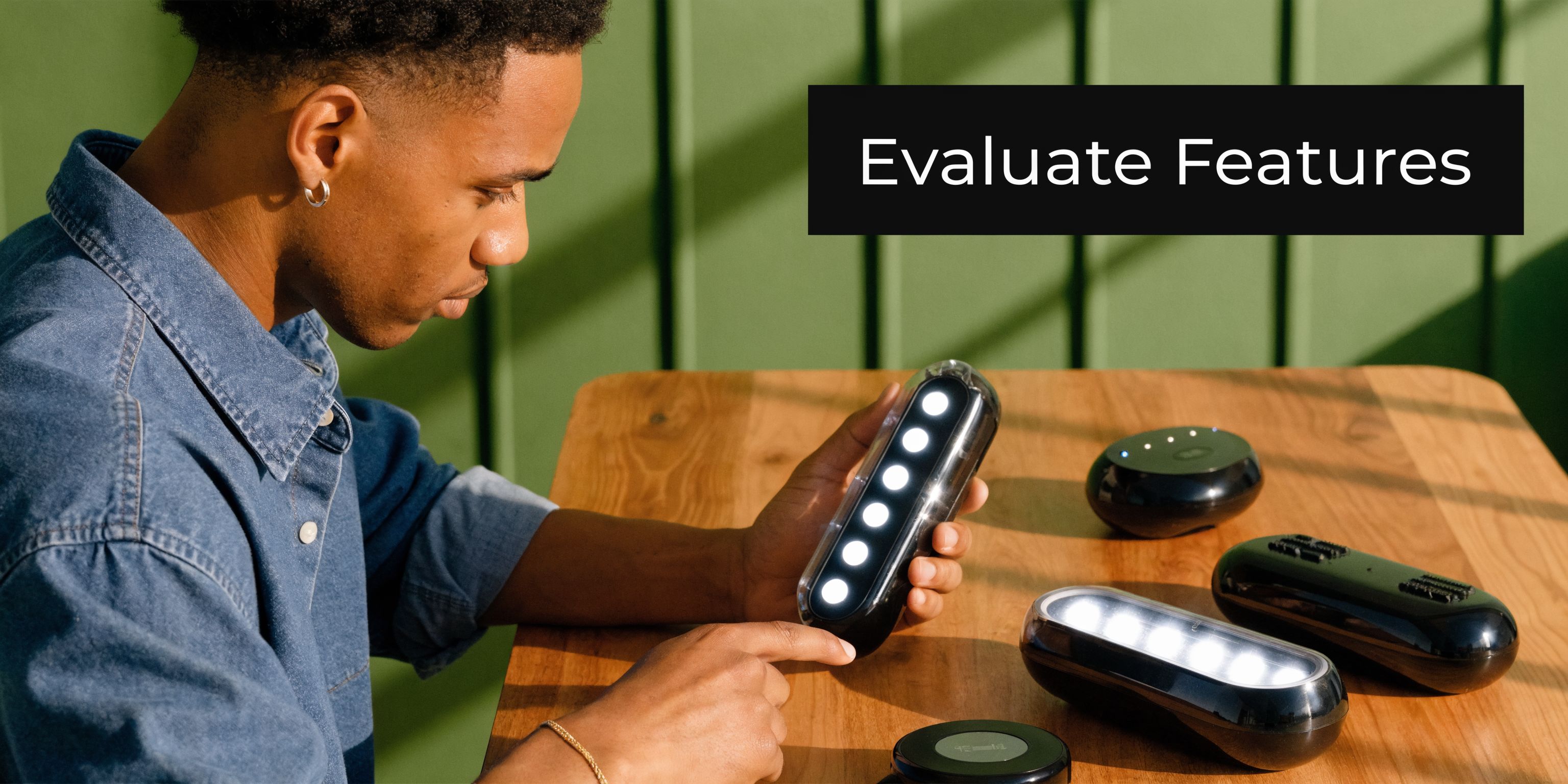
A better way to choose a wearable light therapy device is to ask a different question. What features make it easier to get a useful dose of light, in the right area, often enough to matter?
Start with fit, not marketing
For scalp use, fit changes performance.
A wearable that sits close to the head can deliver light more directly than a device that hovers awkwardly or leaves gaps. For skin use, the same principle applies. You want the light reaching the intended area without constant readjustment.
A rigid helmet may look substantial, but comfort and contour often matter more in day-to-day use. Flexible designs can be easier to wear under a cap or beanie, and they tend to interfere less with normal movement.
Look for signs of thoughtful physical design:
- Close contact: helps light reach the target area more efficiently
- Low-profile form: easier to wear while working or moving around
- Adjustable fit: important if more than one person may use it
- Breathable materials: useful for longer-feeling sessions, especially on the scalp
Check the wavelengths
If a product doesn’t clearly tell you what wavelengths it uses, that’s a warning sign.
For scalp and skin support, the most useful combination is often 660 nm red plus 850 nm near-infrared, because one addresses surface-level tissue and the other reaches deeper. A wearable built around both gives you more versatility than a device that relies on a vague “red light” label.
If you want a simple reference for how different LED colors are used in wellness devices, this guide to LED light therapy color meaning is a practical place to compare modes and purposes.
Irradiance is the spec many miss
The most important technical term to understand is irradiance.
Irradiance tells you the rate at which light energy is delivered to tissue. It’s measured in mW/cm², and it matters more than a flashy LED count because a device can have plenty of bulbs and still deliver weak treatment power at the actual treatment distance.
According to Chroma’s guide on how to choose a red light therapy device, optimal irradiance above 100 mW/cm² at the treatment distance helps meet therapeutic thresholds efficiently, which can reduce session times from 20+ minutes to just a few minutes per area in higher-quality devices.
That doesn’t mean every wearable should be used for only a few minutes. Design, distance, and treatment area all affect how a protocol is set. The main takeaway is simpler: irradiance tells you whether the device can deliver enough energy efficiently.
A quick comparison framework
| Feature | Why it matters | What to favor |
|---|---|---|
| Wavelengths | Determines tissue depth and use case | Clear specs, ideally dual-spectrum for scalp and skin goals |
| Irradiance | Affects dose delivery and time efficiency | Published power density at treatment distance |
| Portability | Influences habit formation | Cordless, rechargeable designs |
| Comfort | Drives repeat use | Lightweight, breathable, flexible wearables |
| Controls | Reduces friction | One-button use, timers, simple mode switching |
Don’t ignore the “will I wear this?” test
Many technically solid devices still fail at this point.
If it requires a special chair, a free wall outlet, or both hands for the whole session, your usage rate may fall fast. By contrast, a cordless wearable with an auto timer asks much less from your day.
That’s why features that sound secondary often become decisive:
- Battery power: lets you use the device away from a fixed station
- Automatic timer: removes the need to watch the clock
- Ventilation: helps prevent the session from feeling stuffy
- Simple controls: makes the routine easy to repeat when you’re tired
One example in this category is Prospek’s cordless LED therapy cap, which uses LED-based 660 nm red and 850 nm near-infrared light with multiple modes in a wearable format designed for hands-free scalp and skin sessions. That matters less as a brand point than as an example of what modern design is aiming for: fewer barriers between intention and use.
If two devices seem similar on paper, choose the one you can picture using on an ordinary Tuesday.
What not to overvalue
Shoppers often get distracted by features that sound impressive but don’t answer the main question.
Be careful about:
- Raw LED count alone: more diodes doesn’t automatically mean better delivery
- Vague claims like “medical grade”: useful only if backed by clear specs
- Bulky form factors: they can reduce the odds you’ll stay consistent
- Confusing mode labels: if you can't tell what each setting does, daily use gets harder
A wearable light therapy device should make treatment feel easier, not more technical. Good design turns a science-backed method into something you’ll use.
Building a Consistent Light Therapy Routine
Individuals often don't quit wellness tools because they stop believing in them. They quit because the routine becomes annoying.
That’s why consistency is the central subject here. Not motivation. Not perfect discipline. Just whether the device fits so naturally into your day that using it feels easier than skipping it.
Attach it to something you already do
The easiest habit strategy is to stop creating a new time block for light therapy.
Instead, pair it with something stable:
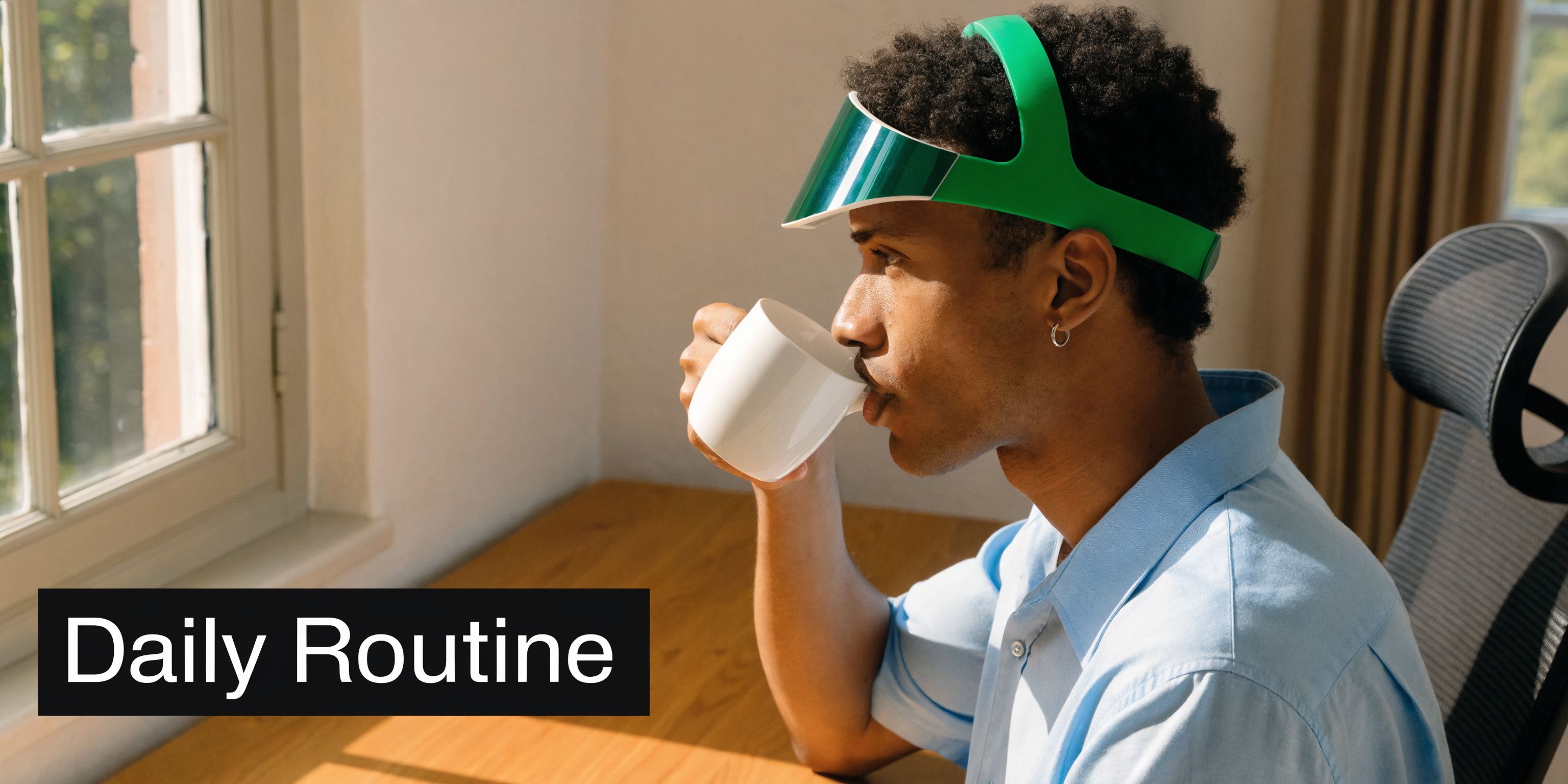
- Morning coffee: put the device on before the first sip
- Desk work: wear it while clearing early emails
- Evening wind-down: use it during a podcast or light reading
- Travel downtime: build it into hotel or airport routines
This works because existing habits act like anchors. You don’t have to remember “do light therapy.” You only have to remember “when I do this, I also wear the device.”
Match the mode to the goal
Many modern wearables include more than one light mode. That can confuse first-time users, but the decision is usually straightforward.
For practical daily use:
- Red mode: often chosen when the focus is more surface-oriented
- Infrared mode: often used when deeper tissue support is the priority
- Combo mode: useful when you want both in the same session
- Blue mode: sometimes included in multi-mode devices for skin-related routines
You don’t need to switch modes constantly to get value. In most cases, a simple repeatable pattern beats frequent experimentation.
Why hands-free design changes adherence
A wearable earns its keep when you forget you're “doing a treatment.”
That’s where portability helps. A device with direct contact and a stable fit doesn’t demand that you sit frozen in one place. It turns treatment from an event into a background routine.
According to iReliev’s discussion of wearable red light therapy devices, long-term safety data for daily 15–20 minute sessions is a key consideration, and wearable devices need features like ventilation to help prevent heat buildup during hands-free use.
That gives you a practical checklist for routine building. If the device is meant for frequent use, it should be comfortable enough for frequent use.
The best schedule is the one that survives busy weeks, travel days, and low-energy evenings.
Safety habits that make sense
LED-based red and near-infrared wellness devices are generally approached as non-ionizing light tools. That’s very different from UV exposure. Still, “safe” doesn’t mean “use carelessly.”
A few sensible rules help:
- Follow the manufacturer’s instructions: mode, timing, and placement matter.
- Keep sessions boringly consistent: more is not always better.
- Pay attention to comfort: heat, pressure, or irritation means something should be adjusted.
- Talk to a clinician if you have a medical condition or are using photosensitizing treatments: that’s especially relevant if your hair or skin changes are sudden or unexplained.
If you want a straightforward walkthrough for daily use, this guide on how to use red light therapy is a useful starting point.
A simple routine beats an ambitious one
People often imagine that results come from doing everything perfectly. Usually they come from doing one reasonable thing regularly.
That’s the hidden advantage of a comfortable wearable light therapy device. It lowers the mental cost of showing up. And with light therapy, showing up is often the part that matters most.
The Future of Your Personal Wellness Routine
At-home wellness tools are getting better, but the core shift is simpler than that. They’re getting easier to live with.
That matters because scalp and skin care rarely improve from occasional bursts of effort. They improve when a helpful practice becomes routine enough to survive normal life. A wearable light therapy device fits that pattern well. It’s non-invasive, straightforward, and built around repeat use rather than one-off intensity.
The science gives the category credibility. Specific wavelengths matter. Dose matters. Device design matters. But in everyday life, the biggest advantage of a wearable is that it removes friction from a habit people want to keep.
That’s why this format is likely to stay relevant. It matches how people behave. They want tools that work at home, at a desk, or while traveling. They want support that doesn’t ask for a clinic calendar or a complicated setup.
Devices like Prospek’s cordless cap reflect that shift by turning LED scalp and skin sessions into something portable, hands-free, and easier to repeat.
Personal wellness is moving toward routines that are more sustainable, not more elaborate. Light therapy wearables fit that future because they make consistency practical.
Frequently Asked Questions
Can I use a wearable light therapy device with hair or skin products?
Usually, yes, but keep the treatment area clean and follow the device instructions. Heavy products on the scalp or skin may affect comfort or how the device sits. If you use medicated products, it’s smart to ask a clinician whether the timing should be separated.
How long does it take to notice changes?
Light therapy works gradually. Users should think in terms of steady routine rather than quick visible change. The better question isn’t “How fast?” It’s “Can I keep using this often enough for long enough to judge it fairly?”
Should I choose red light only or a dual-spectrum device?
That depends on your goal. If your focus is more surface-oriented, red light may be the first feature you look at. If you want a device for both scalp and skin support, a dual-spectrum setup with red and near-infrared usually offers more flexibility.
Is an LED wearable strong enough to be useful?
Yes, if the device is designed well. LED therapy is a legitimate format for wearable use. What matters is not whether it sounds intense, but whether it delivers the right wavelengths with meaningful irradiance and a design you’ll use consistently.
Can I use it every day?
Many wearable routines are built around regular use. Comfort features matter here, especially ventilation, fit, and auto-timing. If daily sessions are part of the product design, the device should feel manageable enough to repeat without strain.
Are there side effects?
Users generally look to LED light therapy because it’s non-invasive and doesn’t involve UV exposure in this category of device. Still, you should stop if a session feels uncomfortable and check with a healthcare professional if you have an eye condition, a photosensitivity concern, or a medical issue affecting the scalp or skin.
Is a wearable better than a panel?
Not in every situation. A panel can be useful for broader treatment areas. A wearable often wins on convenience, proximity, and routine adherence, especially for scalp-focused use. Often, the better device is the one individuals will keep using.
What should I check before buying?
Prioritize the basics:
- Published wavelengths: especially if you want both surface and deeper support
- Irradiance information: a more meaningful spec than LED count alone
- Comfort design: fit, flexibility, and ventilation
- Cordless use: easier for travel and habit formation
- Timer controls: simpler sessions usually get repeated more often
If you want a wearable option built around everyday consistency, Prospek offers a cordless LED therapy cap designed for portable scalp and skin routines with hands-free use, dual-spectrum light, and a simple daily setup.