

Some mornings, the change is small enough to second-guess. A little more scalp showing near the part. A few extra hairs in the sink. Skin that looks tired, uneven, or harder to calm down.
That is when people start looking for something simple. Not a complicated clinic schedule. Not a shelf full of products. Just one routine they can stick with.
Red blue led light therapy sits in that sweet spot for a lot of beginners. It feels modern, but it is not magic. It is a light-based wellness approach that uses specific wavelengths to support how skin and scalp cells work. Used well, it can fit into a busy morning, a travel routine, or a wind-down habit at night.
Many guides stop at facial skincare. They explain red for wrinkles, blue for acne, and leave it there. But scalp use raises different questions. Hair gets in the way. Follicles sit deeper than facial blemishes. Portable cap-style devices change how people use light at home, especially when consistency matters more than intensity.
This guide keeps the science clear and the advice practical. If you have been curious about red and blue light, but unsure what each one does or how to use them safely on the scalp, this guide offers the starting point.
Your Guide to At-Home Light Therapy
A common story goes like this. Someone notices early thinning around the temples, or a scalp that feels irritated after long workdays, dry shampoo, hats, or travel. At the same time, their skin is acting up too. Breakouts on the forehead. Redness around the nose. Texture that no serum seems to smooth.
They want one routine that feels manageable.
That is why at-home LED therapy has become so appealing. It is non-invasive, simple to repeat, and easier to work into daily life than many treatment plans. You do not need to understand every cellular detail on day one. You need to know what each color is meant to do, where it reaches, and how to use it without overcomplicating the process.
Why beginners often get confused
Most confusion starts with color names.
People hear red light, blue light, and sometimes infrared, then assume they all do the same thing with slightly different branding. They do not. Each wavelength interacts with tissue differently, which is why the right choice depends on whether your goal is calming a breakout-prone scalp, supporting visible skin aging, or building a hair wellness routine.
Another point of confusion is the difference between therapeutic LED light and sunlight. Therapeutic LED devices use targeted wavelengths. They are not the same as UV exposure from the sun.
What makes scalp use different
Facial skincare guides assume bare skin and easy device placement. Scalp care is less straightforward.
Hair can block light. Follicles sit below the surface. Portable caps and flexible wearable devices help solve the consistency problem because they keep the light source close to the scalp and make it easier to repeat sessions regularly.
Tip: If a routine is too inconvenient to repeat, it fails. With LED therapy, steady use matters more than turning it into a complicated ritual.
How Red and Blue Light Energize Your Cells
You put on a portable LED cap after a shower, hoping it will do something useful for your scalp. The natural question comes next. What is the light doing once it hits the skin beneath your hair?
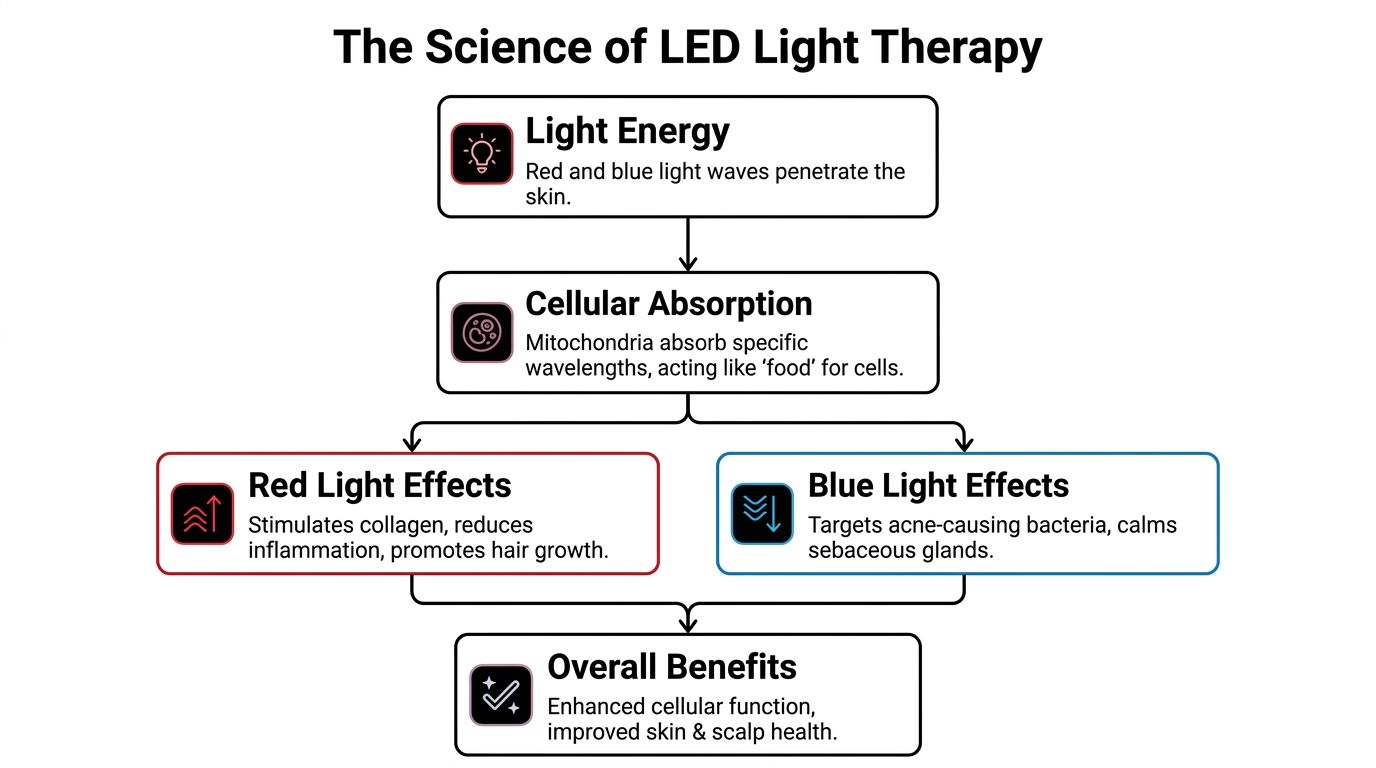
LED therapy works on a simple principle. Specific wavelengths act like signals that help cells carry out normal tasks more efficiently.
That process is called photobiomodulation. The term sounds technical, but the idea is straightforward. Cells receive a light signal, respond to it, and shift their activity in ways that may support repair, balance, and recovery.
The basic chain reaction
Inside your cells are mitochondria, which help produce usable cellular energy. When the right wavelength reaches tissue, parts of the cell can absorb that light and support ATP production. ATP is the fuel cells use for everyday work, including renewal and maintenance.
This process is particularly relevant for skin and scalp, as both rely on hard-working cells. Skin is constantly renewing itself. The scalp also has to support follicles, oil balance, and the surrounding tissue environment. If you want a plain-English overview of the mechanism, Prospek’s explainer on how LED light therapy works is a useful companion read.
For scalp wellness, that matters in a very practical way. Hair can get in the way of light delivery, and follicles sit below the surface. A cap-style device helps by keeping the LEDs close to the scalp in a repeatable position, which is one reason wearables are often more realistic for hair routines than handheld facial devices.
What red light is doing
Red light generally reaches deeper than blue light. It is commonly used for visible skin aging support, recovery, and scalp wellness goals related to the tissue around hair follicles.
Researchers often discuss red light in terms of supporting fibroblasts and other cells involved in repair activity. On the scalp, the practical takeaway is simpler. Red light is usually the color people choose when they want a device aimed at long-term hair and scalp support rather than surface blemishes alone.
Portable cap devices are built around that logic. They are designed to deliver red wavelengths close to the scalp on a regular schedule, which matters because follicles respond better to consistency than occasional, overly long sessions.
What blue light is doing
Blue light works closer to the surface. That makes it more relevant for concerns that also sit near the surface, such as oiliness, clogged follicles, and acne-prone skin or scalp.
Celluma explains that blue light is commonly used in the 415 to 450 nm range for acne-focused treatment goals, where it interacts with surface-level processes linked to blemishes and excess oil (Celluma on the most effective color for LED light therapy).
For the scalp, blue light is more situation-specific than red. It may be useful if your main issue is a breakout-prone, oily scalp. It is usually not the first thing people mean when they talk about hair wellness, because hair-focused routines tend to prioritize follicle support over surface bacteria management.
Why this matters for cap-style devices
Facial LED guides often stop at skin texture and breakouts. Scalp use needs one extra layer of thinking.
A wearable cap has to deliver enough light to the scalp despite hair coverage, sit comfortably enough for regular use, and avoid turning treatment into a complicated routine. Red and blue wavelengths can both play a role, but they are not interchangeable. Red is usually the foundation for hair and scalp support. Blue is the add-on for users dealing with scalp congestion or blemish-related issues.
Why this is different from UV light
Light therapy often gets confused with sun exposure. Therapeutic LED devices use selected visible or near-infrared wavelengths rather than ultraviolet light meant to tan or burn the skin.
The goal is to give cells a usable signal, not to create heat damage or trigger a sunburn response.
A practical way to remember it
Use this beginner shorthand:
- Red light: support, renewal, scalp and follicle wellness
- Blue light: surface-level blemish and oil support
It is a simplified map, but it helps you match the color to the job.
Red Light Versus Blue Light Explained
You are standing in front of the mirror with two different goals in mind. You want a calmer scalp and stronger-looking hair, but you also get occasional bumps along the hairline. That is where color choice starts to matter.
Red and blue light are built for different jobs. The simplest way to sort them is by asking where the problem lives. Is it happening closer to the surface, or is your goal support around the follicle and the skin underneath?
The clearest way to separate them
Red light is usually the better match for deeper support. In at-home routines, it is commonly chosen for visible signs of aging, post-exercise skin recovery, and scalp care aimed at follicle wellness.
Blue light works closer to the skin's surface. It is more often used for blemish-prone skin, excess oil, and scalp situations where congestion or breakout-like irritation are part of the story.
If you want a broader primer on what different LED colors are designed to do, this guide to LED light therapy color meaning gives helpful context.
Red vs. Blue LED Light at a Glance
| Attribute | Red Light Therapy | Blue Light Therapy |
|---|---|---|
| Typical wavelength | 630 to 660 nm | 415 to 450 nm |
| Penetration focus | Reaches into the dermis | Focuses on the upper epidermis |
| Primary target | Fibroblasts and cellular repair activity | Acne-causing bacteria and oil-related surface activity |
| Often used for | Signs of aging, visible redness support, scalp and follicle wellness | Acne support, blemish-prone skin, surface-level scalp issues |
| Main action | Supports collagen and elastin processes, helps calm inflammation | Helps reduce acne bacteria and regulate sebum |
| How it feels conceptually | Restore and reinforce | Clarify and calm |
Where beginners often get confused
It helps to stop treating red and blue like competing versions of the same thing. They act more like two settings on the same appliance. One is meant for deeper support. The other is meant for cleanup closer to the surface.
That distinction matters on the scalp more than it does on the cheeks. Hair creates a barrier. Follicles sit below the surface. A cap-style device also has to deliver light through part lines and hair density, so the most useful color depends heavily on your actual goal.
How this applies to scalp wellness
For hair wellness, red light is usually the foundation. Portable LED caps are generally designed with that in mind because the target is often the follicle environment rather than surface bacteria alone.
Blue light has a narrower role on the scalp. It can make sense if you deal with oiliness, tender bumps, or acne-like congestion around the scalp and hairline. If your main concern is shedding, early thinning, or supporting fuller-looking hair, red is usually the more practical place to start.
A simple way to remember it is this. Red supports the garden below the soil line. Blue helps tidy what is happening on the surface.
A smarter way to choose for a cap-style device
Ask what you want the cap to do during most sessions.
- If you want follicle support and hair wellness, red is usually the priority.
- If your scalp is oily, breakout-prone, or congested, blue may be useful.
- If both are true, a dual-spectrum device or alternating protocol may fit better than using blue alone.
That last point is easy to miss. Many facial LED guides focus on wrinkles versus acne. Scalp care asks a different question. Can the device support the follicle area while still helping with surface irritation if you need it to?
One practical caution
Blue light is not automatically better just because a scalp problem looks like a breakout. Some scalp irritation is not acne, and some causes need a dermatologist rather than more home treatment. If bumps are persistent, painful, spreading, or linked with heavy shedding, it is worth getting the scalp assessed before choosing a color based on appearance alone.
Unlocking Benefits for Scalp and Skin
You put on an LED cap hoping it will help your hair look fuller, then wonder whether the same session is doing anything for the skin on your scalp. That question matters. Scalp treatment is not just facial skincare shifted upward a few inches.
Skin and scalp can both respond to light, but they usually need different priorities. On the face, people often focus on smoothing, clarity, and visible tone. On the scalp, the goal is usually a healthier setting for follicles, with less irritation, less buildup, and better day-to-day comfort.
What red light can do for skin
Red light is usually chosen for repair-focused skin goals. People use it when skin looks tired, uneven, or easily irritated, and when they want support for firmness and texture over time.
As noted earlier, red light has been studied for skin-rejuvenation uses. In practical terms, that means it is often the better match for concerns tied to recovery and visible calm rather than active breakouts.
What blue light can do for skin
Blue light has a narrower role. It is typically used for blemish-prone skin, especially when the concern sits closer to the surface.
That makes it relevant for the hairline too. If breakouts cluster along the forehead, temples, or just under the cap edge, blue light may help fit into a routine without adding another drying topical product.
Why scalp benefits need their own conversation
Hair wellness depends on more than the strand you can see. The follicle sits below the surface, inside tissue that can become oily, inflamed, tender, or congested. A cap-style device has to work through hair coverage, reach the scalp consistently, and do so safely over repeated sessions.
That changes the conversation.
A facial guide might ask whether you want help with wrinkles or acne. A scalp guide has to ask different questions. Are you trying to support thinning areas? Calm an uncomfortable scalp? Reduce bumps around follicles? Keep oil and buildup from interfering with a healthy scalp routine?
How the benefits split in real life
Red light is usually the main tool for scalp and hair-focused goals because those goals involve the follicle environment. You can picture it like tending roots rather than polishing leaves. The visible result you care about is hair, but the target area is the skin and tissue around the follicle.
Blue light fits better when the surface is the issue. If your scalp gets greasy fast, develops acne-like bumps, or feels congested near the hairline, blue light may help as part of a cleanup strategy. It is less often the lead choice for someone whose main concern is shedding or early thinning.
Where portable LED caps fit
This is easy to miss with wearable devices. A cap can be convenient, but convenience does not erase the need to match the light color to the job.
For many beginners using a cap-style device, red is the starting point because it aligns better with common hair-wellness goals. Blue may be added more selectively, especially for short sessions on oily or breakout-prone areas. If a device offers both colors, use the brand's timing guidance carefully instead of assuming more minutes will mean better results.
A safe way to set expectations
LED therapy can support scalp and skin care, but it does not replace diagnosis when symptoms are persistent. Ongoing pain, spreading rash, thick scale, sudden heavy shedding, or sore bumps deserve medical attention before you keep experimenting at home.
A simple rule helps here. Use red when your priority is follicle support and a calmer scalp environment. Use blue when your priority is surface congestion and blemishes. If both concerns show up together, your routine needs a little more strategy, not just more exposure time.
Maximizing Results With Dual-Spectrum Technology
Single-wavelength therapy can be useful. Dual-spectrum therapy expands the job.
That matters because skin and scalp concerns rarely stay in one layer. A person with thinning may also have inflammation. Someone focused on recovery may also want support closer to the surface. Combination devices become more interesting when addressing these concerns.
Why red plus near-infrared gets attention
Red light reaches the dermis and supports repair-related processes. Near-infrared, often shortened to NIR, penetrates deeper.
Research summarized by LED Therapy Lights notes that combining red light at 630 to 660 nm with near-infrared at 850 nm produces synergistic biological effects. Red supports epidermal repair and collagen synthesis, while NIR penetrates deepest to address wound healing and deeper dermal regeneration. That combination is especially valuable for scalp applications where follicles sit deeper in the tissue (LED Therapy Lights on red, blue, and infrared light choices).
Why this matters more on the scalp than on the cheek
A cheek treatment mostly deals with open skin surface. The scalp adds depth and obstruction.
Hair can reduce direct exposure. Follicles are not sitting at the very top layer. If your device can address both surface and deeper tissue support in the same session, that can make a scalp routine more practical.
The one-two punch idea
Picture it this way:
- Red light supports the layers where repair signaling and collagen-related activity matter.
- Near-infrared reaches farther into tissue where deeper regeneration and inflammatory support become relevant.
That does not mean more wavelengths are always better in every situation. It means combination modes can make more sense when one concern overlaps another.
Where blue fits into the bigger picture
Blue is still useful, but it plays a different role.
If your goal is primarily scalp comfort, visible thinning support, or broader tissue wellness, red plus NIR is often the more natural pairing. If your scalp also gets congested or breakout-prone, blue may become a supplemental mode rather than the main event.
Tip: Think of blue as scalp-surface support. Think of red plus NIR as broader tissue support.
Why wearable design matters
A strong therapy concept can still fail in everyday use if the device is awkward.
For scalp care, wearable LED designs solve a practical problem. They help keep the light source close to the target area and make it easier to repeat sessions in a consistent way. That is important because uneven use creates uneven habits, and uneven habits limit results.
Building Your Personal LED Therapy Routine
The best routine is not the most aggressive one. It is the one you can repeat safely and consistently.
That is especially true for scalp care, where users are building a habit over time rather than chasing overnight changes.
Start with a moderate schedule
Because long-term daily scalp data is still limited, a moderate starting routine makes sense for many individuals.
One source discussing this gap notes that optimal protocols for combining red and blue light on the scalp are still largely unexplored. It also suggests that a short burst of blue followed by a longer red/IR session may be effective for inflamed scalps causing shedding (Eye Candy on red light vs blue light therapy).
A beginner-friendly routine often looks like this:
- For scalp wellness and thinning support: Start with 3 to 4 sessions per week.
- For wearable cap sessions: Stay within the device’s intended use window, often 15 to 20 minutes.
- For combination concerns: Consider using blue briefly for scalp-surface issues, then shifting to red or red plus infrared for deeper support.
Match the mode to the problem
If your scalp feels mostly irritated or blemish-prone, blue may deserve some attention early in the routine.
If your concern is visible thinning or a stressed, uncomfortable scalp, red or red plus infrared makes more sense as the anchor. People often get better adherence when they choose one primary goal first instead of trying every mode every day.
Keep your setup simple
You do not need a ten-step ritual.
Try this:
- Use the device on a clean, dry scalp when possible.
- Place it consistently so the same target zones get regular exposure.
- Track with photos every few weeks in the same lighting.
- Give the routine time before deciding it is not working.
Safety checks that matter
Before starting, run through a few basics:
- Device quality: Choose an LED device with clear specifications and intended-use guidance.
- Medication review: If you take photosensitizing medications, ask a clinician before using light therapy.
- Health context: Pregnancy, active skin disorders, or a history of unusual light sensitivity are good reasons to check first.
- Comfort level: Stop if the treatment feels irritating or if your scalp becomes unusually reactive.
Tip: Consistency beats intensity. A calm, repeatable routine is usually smarter than pushing for daily use right away.
What to expect early on
Beginners often expect visible changes far too quickly.
In reality, early wins may be subtle. A calmer-feeling scalp. Less irritation around the hairline. Skin that looks less angry. Those small signs matter because they tell you the routine is tolerable and sustainable.
Answering Your Top Questions About LED Caps
Portable LED caps raise practical questions that facial masks do not. That is a good thing. It means people are thinking about real-world use instead of marketing language.
Is it safe to use an LED cap every day
This is one of the most common questions, and the honest answer is nuanced.
A UCLA Health discussion of red light therapy notes that short-term benefits and safety are supported, but longer-term data remains limited in some use cases. One of the major unanswered questions is the long-term safety of daily LED therapy on the scalp. While short-term trials of 8 weeks show high safety and efficacy, data on cumulative effects over 6 to 12 months is sparse. For that reason, a moderate approach of 3 to 4 sessions per week with progress monitoring is a sensible place to begin (UCLA Health on red light therapy benefits and safety considerations).
So yes, home LED use can fit safely into many routines, but more is not automatically better.
Will an LED cap get hot under a hat
People worry about heat because they imagine something like a warming pad on the scalp.
LED devices are generally favored in part because they avoid the kind of heat generation associated with other light sources that can denature target enzymes, as noted in the earlier section on wavelength combinations. In practical use, comfort still depends on the device design, ventilation, and session length.
If a cap or insert feels stuffy, shorten the session and make sure it is being used as directed.
How long until I see results for hair thinning
Patience matters for hair thinning.
Scalp and hair routines move slower than breakout care. Skin turnover is one timeline. Hair appearance is another. Individuals typically do best when they stop hunting for daily changes and instead compare monthly photos.
For a deeper look at wearable devices specifically, Prospek’s guide to the red light therapy cap covers common use questions.
Can blue light reach hair follicles
Not in the same way red or near-infrared can.
Blue light is more relevant at the surface. That does not make it useless on the scalp. It makes it better suited for scalp-skin concerns than deeper follicle support.
Should I choose red blue led light therapy or just one color
If you have one clear goal, one color may be enough.
If your scalp is both irritation-prone and thinning-focused, combined use may make more practical sense. The key is not to stack modes randomly. Use each one for its intended role.
Key takeaway: LED caps work best when they support a realistic routine. Choose the wavelength based on the tissue problem, then stay consistent.
If you want a portable way to turn this into a routine you will keep, Prospek offers a cordless LED therapy cap built for comfortable scalp sessions at home or on the go, with simple controls, wearable design, and modes that support a practical red blue led light therapy habit.