

You get home from your Botox appointment, glance at your LED device, and pause. You want the smooth forehead, softer frown lines, and refreshed look you paid for. You also don't want to do one well-meaning session that interferes with your results.
That question comes up all the time with clients. They already have a solid skin routine, they know red light therapy feels gentle, and they assume gentle means immediate. With red light therapy after botox, the answer is a little more nuanced. It can be a smart pairing, but timing matters.
The good news is that you don't need to choose between them. Botox and LED-based red light therapy work in different ways, and when you combine them carefully, they can support different parts of the same goal. Botox helps relax the muscle activity behind expression lines. Red light therapy supports skin recovery and overall skin quality.
What matters most is knowing when to wait, why to wait, and how to restart safely. Once that part is clear, the whole routine feels much less confusing.
Your Guide to Combining Botox and Red Light Therapy
A very typical client scenario goes like this. She books Botox before an event, follows the basic aftercare, then remembers she also uses LED several evenings a week. Her next question isn't whether red light therapy is good for skin. It's whether using it too soon could affect where the Botox settles.
That's the right question.
Botox appointments are quick, but the first couple of days afterward are not the time to experiment. Your injector placed the product with precision. Early aftercare is about protecting that placement while your skin calms down and the treatment begins to settle into the intended muscles.
At the same time, it's understandable to want your LED routine back. Many people use red light therapy for skin comfort, post-treatment calm, and long-term texture support. So the goal isn't to avoid it forever. The goal is to use it in a way that supports your results instead of competing with the settling phase.
Simple mindset: Treat Botox as the priority first, then bring LED back in once that early window has passed.
Clients often feel better once they understand one key idea. The delay isn't arbitrary. It's based on how Botox behaves in the tissue right after injection and how light-based therapy can influence circulation and skin response.
Once you know that, the aftercare plan gets much easier. You stop guessing. You stop overthinking every session. And you can build a routine that protects your injectable results while still giving your skin the benefits of LED support.
Understanding How Each Treatment Works on Your Skin
Botox and red light therapy both fit into modern aesthetic care, but they don't do the same job. That difference is what makes them useful together.

Botox works on muscle signals
Think of Botox like a dimmer switch for overactive facial movement.
When your injector places Botox into selected muscles, the goal is to soften repeated contractions that create dynamic wrinkles such as frown lines and crow's feet. It doesn't resurface the skin. It doesn't exfoliate. It doesn't rebuild collagen directly. Its main role is to reduce the muscle activity that folds the skin over and over.
That's why someone can have smoother movement-related lines after Botox but still want help with texture, glow, or firmness. Those concerns live more in the skin itself.
LED red light therapy works on skin cells
LED-based red light therapy acts more like a battery charger for your skin cells.
Red light therapy uses 630-660 nm red and 830-850 nm near-infrared light, and one review notes it can increase ATP production by up to 150% in fibroblasts, support collagen synthesis, and show significant reductions in skin roughness after consistent use over 12 weeks (infraredi on red light therapy after botox). In plain language, that means the light is aimed at helping skin cells do repair work more efficiently.
If you want a simple breakdown of the mechanism, this overview of how LED light therapy works is a helpful companion to the science.
Why people confuse the two
Both treatments are used for anti-aging, so people assume they overlap completely. They don't.
A simple comparison helps:
| Treatment | Main target | What you notice |
|---|---|---|
| Botox | Facial muscle activity | Softer expression lines |
| LED red light therapy | Skin cell energy and repair | Calmer-looking skin, smoother texture, better overall skin quality |
That distinction matters. One works below the wrinkle pattern by changing muscle behavior. The other supports the skin around and above it.
Used together, they can be complementary. Botox helps reduce the folding action. LED helps support the skin's appearance and recovery.
When clients understand this separation, they stop asking, "Which one is better?" and start asking the smarter question, "How do I time them so they work well together?"
The Critical Waiting Period After Botox Injections
The most important rule with red light therapy after botox is also the easiest to remember. Wait first.
A key consensus among dermatologists is to wait 24 to 48 hours after Botox injections before red light therapy so the neurotoxin can bind properly, since red light therapy can increase circulation and could potentially interfere with that early settling process (Maysama's guide on red light therapy after Botox).
Why the delay matters biologically
Right after injection, Botox hasn't finished doing its job.
Your injector has placed it into very specific muscles for a reason. In the first day or two, the treatment needs time to localize and begin binding where it was intended. During that window, most providers want you to avoid anything that could add unnecessary pressure, warmth, or increased circulation to the treated area.
That doesn't mean LED is dangerous by default. It means timing affects predictability.
Red light therapy is known for supporting circulation and calming inflammation. Those are benefits later. Too early, they can be the reason providers prefer caution.
What people often get wrong
The common misunderstanding is this: "If red light is gentle, I can use it right away."
Gentle is not the same as well-timed.
Even a noninvasive treatment can be poorly timed if it affects the exact area where an injectable is still settling. This is why experienced injectors often group post-Botox advice into one broad principle. Keep the area quiet at first.
That usually means avoiding things like:
- Direct pressure on treated skin from tight devices or rubbing
- Extra heat exposure in the very early period
- Anything that stimulates circulation aggressively before the product has had time to settle
Why patience protects your investment
Most Botox disappointment doesn't come from waiting. It comes from doing too much too soon.
If someone uses LED immediately, they may still be fine. But aftercare shouldn't be based on luck. It should be based on giving the treatment the best chance to settle exactly where your injector intended.
Practical rule: The first couple of days after Botox are for protection, not optimization.
That small pause often makes clients feel less anxious because it reframes the wait. You're not missing out on skin benefits. You're protecting the precision of a treatment that depends on precision.
A Safe Timeline for Reintroducing Red Light Therapy
The safest approach to red light therapy after botox is to think in phases, not just one magic restart day.
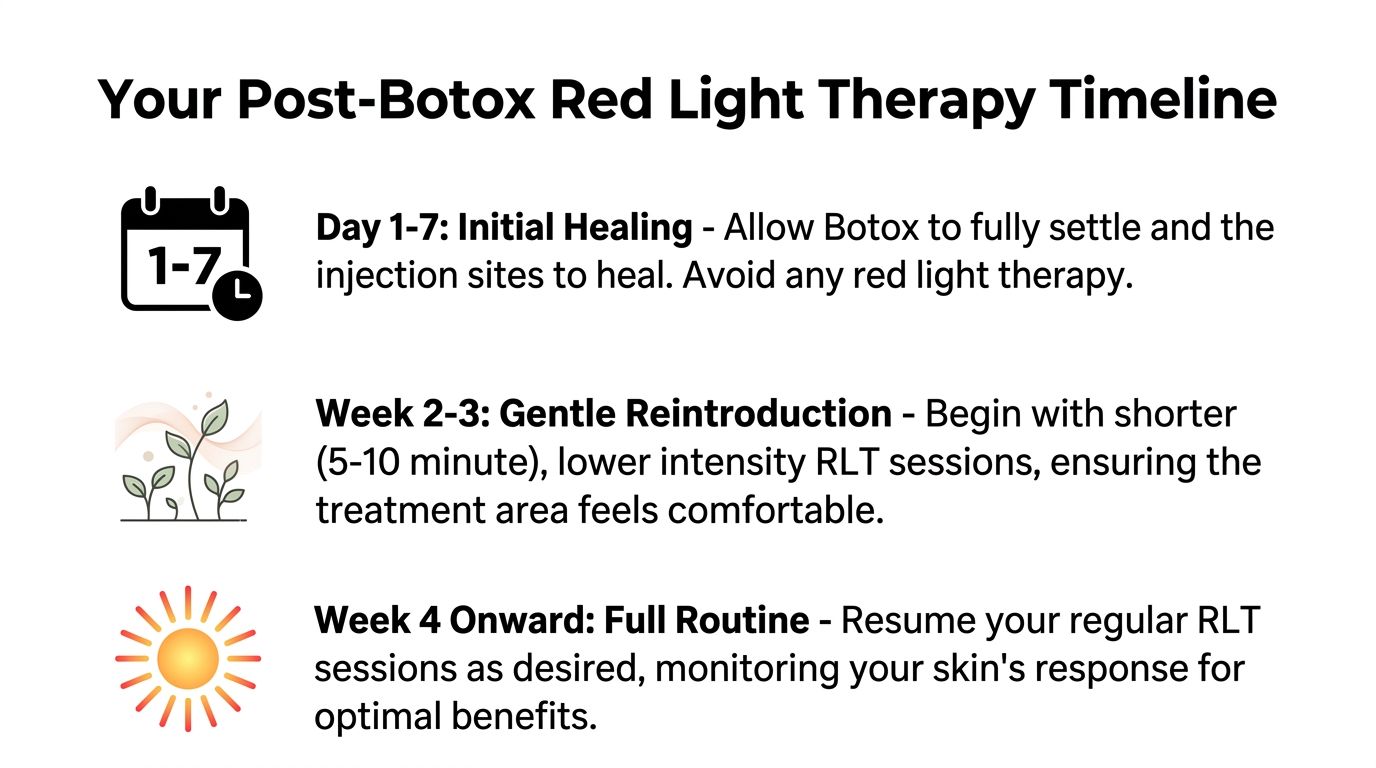
One source notes that photobiomodulation after Botox can reduce post-injection edema by 35-50% within 72 hours, with protocols calling for a 24-48 hour deferral followed by sessions 3 times per week (Youlumi on red light therapy after Botox). That gives us a useful framework, but your own injector's instructions still come first.
For practical session planning, this guide on how to use red light therapy is useful once you're ready to restart.
The first phase
Day 0 through the early settling period
This is your no-go window for facial LED over the treated area. Keep things simple. Cleanse gently, avoid rubbing, and let the injection sites settle.
If you're tempted to "help" with recovery right away, resist that urge. Early aftercare is about restraint.
The second phase
After the waiting window has passed
Once you've cleared the initial deferral period and your injector hasn't given you different instructions, reintroduce LED cautiously. Start gentle. You don't need a heroic first session.
A smart reentry looks like this:
- Keep sessions short at first. If your normal routine is longer, ease back in.
- Pay attention to comfort. The area should feel calm, not overheated or irritated.
- Use a low-pressure setup. Avoid pressing anything firmly onto fresh treatment areas.
- Stay observant. If something feels off, stop and check with your provider.
The third phase
The following weeks
If your skin stays comfortable and your Botox is settling nicely, you can move toward a regular rhythm. The same source above describes protocols using sessions 3 times per week after the deferral period.
That doesn't mean more is always better. Consistency matters more than intensity.
A quick do and don't guide
| Do | Don't |
|---|---|
| Wait through the early settling window | Use LED on the same day as injections |
| Restart gently | Jump straight into an intense routine |
| Follow your injector's aftercare first | Assume every face and injection pattern is the same |
| Pause if the area feels unusual | Push through swelling, discomfort, or asymmetry |
Clients often ask whether they need to wait much longer than the minimum. Sometimes a provider does extend the timeline based on bruising, swelling, placement, or your own history with injectables. That's normal. Personalized aftercare is a strength, not a contradiction.
The easiest way to think about the timeline is this. First, leave Botox alone. Then, gently reintroduce LED. Then, build consistency.
How Red Light Therapy Can Enhance Your Botox Results
Once the waiting period is over, LED becomes much more interesting. Then, red light therapy after botox shifts from "something to be careful with" to "something helpful." 
Botox softens the movement that creates expression lines. LED supports the skin environment around those results. That's why the pairing can feel so satisfying when it's done correctly. You're addressing both the muscular cause of some wrinkles and the visible quality of the skin itself.
It can make recovery look calmer
This is the first benefit many clients notice.
After injections, the skin may look slightly pink, puffy, or bruised. A clinical source reports that 81% of patients using an LED system after in-clinic treatments, following a 72-hour wait, achieved significant improvement in periorbital wrinkles, and other research noted in the same source says red light therapy can help scars heal in half the time (Omnilux on enhancing in-clinic skin treatments with LED light therapy).
That kind of result makes sense to clients because it lines up with what they want after Botox. Less visible downtime. Faster return to normal-looking skin. More comfort with less fuss.
It helps where Botox doesn't
Botox is excellent for dynamic wrinkles. It doesn't directly improve rough texture, dullness, or the general look of tired skin.
LED fills that gap.
When someone says, "My forehead lines are softer, but I still want my skin to look healthier," they're describing the exact reason these treatments can work well together. LED-based red light therapy supports skin quality. That may mean a smoother look, a fresher tone, or a more rested overall finish.
Here's a practical way to think about the pairing:
- Botox handles movement-related creasing
- LED supports skin recovery
- Ongoing LED use can complement the polished look people want after injectables
A short visual can help reinforce how people fit LED into broader treatment plans after the initial wait:
It supports a more complete anti-aging strategy
Clients are often happiest when their results don't look like "just Botox." They want smoothness, yes, but also brightness, softness, and skin that looks well cared for.
That's where LED earns its place. It supports the canvas Botox sits on.
Red light therapy doesn't replace Botox, and Botox doesn't replace good skin support. Together, they can create a more balanced result than either one alone.
Used this way, LED isn't an extra gadget in your routine. It's a support tool that helps your skin look more settled, more comfortable, and more refined around your injectable results.
Warning Signs and When to Pause Your Therapy
Problems are rare for those who wait appropriately and restart gently. Still, it's smart to know what should make you pause.
The first category is more-than-expected reaction around the treated area. If swelling seems to worsen instead of calm down, or if redness becomes more noticeable after you restart LED, stop using the device and check in with your injector.
The second category is movement changes that don't look right. Botox works by intentionally relaxing specific muscles. If you notice unexpected asymmetry, unusual heaviness, or weakness in a nearby area that wasn't meant to be affected, don't keep layering treatments on top of that. Pause and get professional guidance.
Signs worth paying attention to
- Swelling that seems to increase instead of gradually settle
- New tenderness or irritation that appears after LED sessions
- Visible asymmetry that concerns you
- A feeling that an area is responding oddly compared with your usual Botox experience
What to do next
You don't need to panic. You do need to simplify.
Stop LED for the moment. Take a few clear photos in natural light. Then contact the clinic that performed your injections. That gives your provider the best chance to advise you based on your placement, dose pattern, and timing.
If your skin or movement looks unusual after reintroducing LED, don't troubleshoot endlessly at home. Pause first, then ask your injector.
A good rule is this. Mild post-injection quirks can happen. Persistent changes, increasing irritation, or anything that feels off deserves real follow-up.
Using Your Prospek Cap Safely After Botox
A portable LED device is easiest to use well when it doesn't tempt you to overcomplicate the process. That's where a simple, hands-free setup helps.

Prospek is built around 660 nm red and 850 nm near-infrared LED light, with a cordless design, breathable materials, and smart ventilation. For someone easing back into light use after Botox, those details matter because comfort and consistency usually matter more than intensity.
What safe use looks like in real life
If you've had Botox near the upper face, your safest habit is still the same one covered earlier. Wait through the early settling period, then resume gently.
After that, a wearable LED format can make it easier to stay consistent without handling a device against your face or fussing with setup. You can learn more about the device style in this overview of the red light therapy cap.
A practical routine with a device like this should focus on:
- Comfort first. If the treatment area feels sensitive, don't force a session.
- No unnecessary pressure. Wear the device in a way that feels easy and natural.
- Steady scheduling. A routine you can maintain beats a burst of overuse.
- Good judgment. If your injector gave custom timing instructions, follow those over any general plan.
Why portability helps
Clients are more likely to use LED consistently when it fits into ordinary life. Sitting on the couch, reading, answering a few emails, or winding down in the evening is often how habits stick.
That matters because post-Botox LED isn't about one dramatic session. It's about integrating a supportive skin routine at the right time, in a form you'll continue using.
The Final Takeaway Wait Watch and Enhance
The safest approach to red light therapy after botox comes down to three words. Wait, watch, enhance.
Wait through the initial post-injection window so Botox can settle without unnecessary interference. That's the part many people want to rush, and it's the part that protects your result.
Watch your skin and facial movement when you restart. A gentle return is better than a fast one. If anything looks unusual, pause and let your injector guide the next step.
Enhance once the timing is right. That's where LED can become a very useful partner. Botox addresses expression-related lines. Red light therapy supports recovery and skin quality. Together, they can create a smoother and more polished overall result when used thoughtfully.
Clients usually feel most confident when they stop looking for one rigid rule and start thinking in terms of sequence. Protect the injections first. Reintroduce LED with care. Then stay consistent.
That's the goal. Not doing more. Doing the right things in the right order.
If you want a portable, easy-to-stick-with LED option for your long-term routine, take a look at Prospek. Its cordless, hands-free design and dual-spectrum LED setup make it simple to build consistent red light sessions into real life, whether you're at home, working, or traveling.