

Light therapy offers a promising, drug-free approach to managing the frustrating cycle of eczema, helping to calm the relentless itching and redness. It’s all about using specific, healing wavelengths of light to quiet down inflammation and encourage your skin's own repair mechanisms. The key difference from older methods is the shift to modern LED-based therapies, which are much safer and more accessible.
Let's take a look at the core principles of using light therapy for eczema.
Light Therapy for Eczema at a Glance
For a quick overview, here's a summary of what light therapy brings to the table for managing eczema symptoms.
| Aspect | Description |
|---|---|
| Primary Goal | To reduce inflammation and itchiness by calming the skin's overactive immune response. |
| Mechanism | Specific wavelengths of light (primarily red and near-infrared) penetrate the skin, energizing cells to promote healing and reduce swelling. |
| Key Benefit | Offers a non-pharmaceutical option to manage chronic symptoms, complementing traditional treatments. |
| Modern Technology | Uses LEDs to deliver targeted light without the harmful UV radiation associated with older clinical phototherapy. |
| Outcome | Aims for a stronger skin barrier, fewer flare-ups, and faster recovery. |
This approach is all about working with your body to restore balance, not against it.
How Light Therapy Helps Soothe Eczema
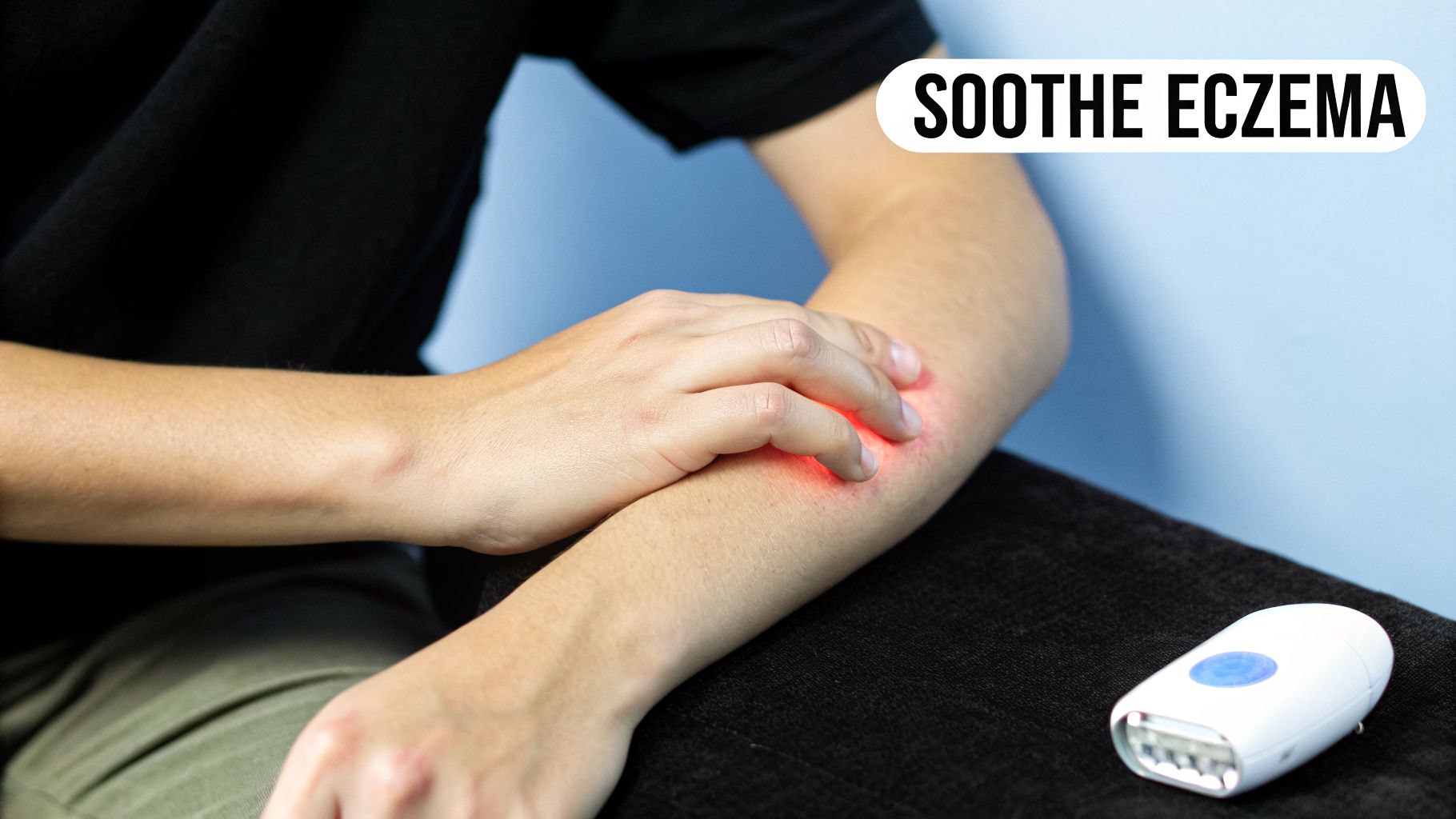
If you have eczema, you know the battle all too well. It’s a constant struggle against an invisible trigger that leaves your skin itchy, inflamed, and painful. While creams and medications are the standard go-to, many of us are searching for something more—a way to manage symptoms without relying solely on pharmaceuticals and their side effects.
This is exactly where light therapy comes in. Think of it this way: just as a plant uses sunlight to create energy and thrive, your skin cells can harness specific kinds of light to power their own repair processes. We're not talking about just any light, but very precise wavelengths that have a unique, beneficial conversation with your body at a cellular level.
Targeting the Source of Inflammation
At its heart, eczema is an inflammatory issue. An overactive immune response sends your skin into a frenzy, causing the tell-tale redness, swelling, and maddening itch. Certain wavelengths of light, especially red and near-infrared from an LED source, have been clinically observed to gently dial down that inflammatory reaction.
This works by reaching beneath the skin's surface to give your cells a much-needed energy boost. The light is absorbed by the mitochondria—the tiny "powerhouses" inside every cell—which helps them work more efficiently. This leads to a cascade of positive effects for skin prone to eczema:
- Reduced Inflammation: It helps calm the overzealous immune cells responsible for redness and swelling.
- Promoted Healing: It gives your skin the resources it needs to repair itself and recover from a flare-up.
- Improved Cellular Function: It fuels your skin cells, helping them build a stronger, more resilient barrier against triggers.
The goal isn’t to shut down your immune system, but rather to help it find its balance again. By giving cells a clean source of energy, LED therapy helps the skin calm itself and function more normally, breaking that vicious itch-scratch cycle.
Why LED Light Is a Modern Approach
Now, it’s really important to draw a line between modern LED therapy and what people might think of as traditional phototherapy. For years, clinical treatments have used ultraviolet (UV) light. While effective for some, UV light comes with well-known risks and must be administered under strict medical supervision.
Thankfully, the technology has moved on. Today's at-home devices use Light Emitting Diodes (LEDs) that focus on the visible red and invisible near-infrared parts of the light spectrum. These wavelengths have a fantastic safety profile and are celebrated for their healing and restorative benefits, completely avoiding the DNA damage associated with UV radiation. This evolution makes LED therapy a gentle, effective tool you can use consistently at home to support your skin’s long-term health from the inside out.
The Journey of Light Therapy from Sunlight to Science
Using light to soothe troubled skin might seem like a recent wellness trend, but it's an idea with roots stretching back thousands of years. It began with a simple, intuitive observation: sunlight has a powerful effect on our skin.
What we now call light therapy for eczema is the modern, scientific refinement of that ancient wisdom. Understanding this journey—from sunbathing to precision LEDs—shows that at-home light therapy isn't just a fleeting fad. It’s the next logical step in a long-trusted medical practice, finally made accessible.
From Ancient Sun Worship to Scientific Breakthroughs
The history of light as medicine is as old as civilization itself. The earliest records of using light to treat eczema-like conditions date back over 3,500 years to ancient Egypt. They practiced what we now call heliotherapy—controlled exposure to sunlight—to manage persistent skin ailments. They didn't know the science, but they saw the results.
This idea simmered for centuries until the late 1800s, when a Danish physician named Niels Ryberg Finsen started connecting the dots scientifically. His groundbreaking work, which included using focused red light to heal smallpox scars, earned him a 1903 Nobel Prize in Medicine. Finsen was the first to prove that specific wavelengths of light could treat skin diseases by targeting the problem at its source. You can read more about these historical milestones and how they paved the way for modern dermatology.
The Clinical Era of Phototherapy
Finsen's discoveries kicked off the clinical era of phototherapy in the 20th century. Dermatologists began using machines that delivered controlled doses of ultraviolet (UV) light to treat severe psoriasis and, later, stubborn eczema. It worked by suppressing the overactive immune response that drives these conditions.
But there was a catch. This approach had major downsides. It required frequent trips to a clinic, relied on expensive, bulky equipment, and involved exposing patients to potentially harmful UV radiation. Because of the risks, it was typically reserved for only the most severe cases and wasn't a practical long-term solution for most people.
The big question for decades was: how can we isolate the healing benefits of light without the risks of UV exposure? The answer, surprisingly, came from NASA.
The Dawn of the LED Age
The next major leap came from an unexpected place: space exploration. In the 1990s, NASA scientists were experimenting with Light Emitting Diodes (LEDs) to figure out how to grow plants on space missions. They noticed something incredible—the specific wavelengths of red light used for photosynthesis also seemed to accelerate skin healing for the astronauts.
This was the breakthrough everyone had been waiting for. LEDs made it possible to isolate the most beneficial wavelengths—like red and near-infrared light—and deliver them safely, without any of the harmful UV rays.
That discovery led directly to the safe, targeted, and convenient at-home devices we have today. Modern light therapy for eczema is built on this very principle, using focused, non-UV light to:
- Reduce inflammation deep within the skin.
- Energize skin cells to kickstart repair and healing.
- Offer a gentle alternative to harsh clinical treatments.
Thanks to this incredible evolution, the power to calm eczema with light is no longer locked away in a specialist’s office. It's a tool you can use to find relief and regain control, right from the comfort of your own home.
Unlocking Your Skin's Healing Power with LED Light
It might sound strange to treat angry, itchy skin with light, but it's not magic—it's biology. The relentless cycle of eczema is fueled by inflammation, and specific wavelengths of light have a unique ability to dial down that inflammatory response right at the source.
We’re talking about Red and Near-Infrared (NIR) light in particular. These wavelengths act like a targeted intervention, giving your skin cells the tools they need to heal from within. This is a world away from simply managing surface-level symptoms; it’s about restoring healthy function.
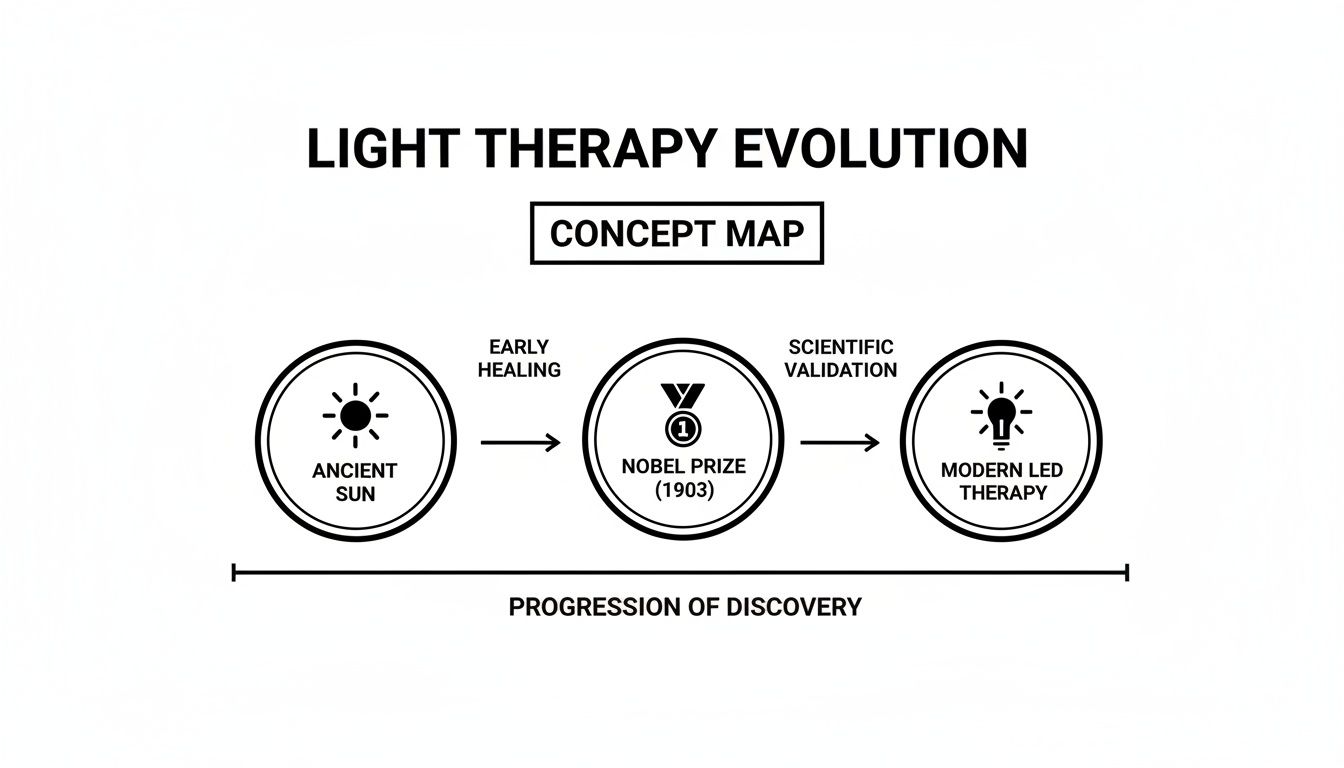
As you can see, our understanding of light's healing properties has come a long way. What began with ancient sun worship has evolved into a precise, scientifically-backed therapeutic tool.
Energizing Your Skin's Cellular Batteries
To really get what's happening, you have to think small—cellular level small. Every one of your skin cells is powered by tiny engines called mitochondria. They are the powerhouses that produce the energy needed for everything a cell does, from defending itself to repairing damage.
During an eczema flare-up, these cellular engines get overworked and just can't keep up. They become sluggish, perpetuating a frustrating cycle of inflammation and damage that your skin can't seem to break on its own.
This is where the light comes in. Specific wavelengths of red and near-infrared light are able to penetrate the skin and get absorbed directly by those struggling mitochondria. The light gives them a direct energy jolt, ramping up their production of ATP (adenosine triphosphate)—the high-octane fuel that powers all cellular activity.
The Soothing Cascade Effect
Once your cells are recharged, a powerful chain reaction kicks off. This isn't just about calming the itch; it's about fundamentally changing the environment in your skin to one that promotes healing.
This cellular energy boost leads to several key benefits:
- Reduced Inflammation: Energized cells are better at regulating the local immune response. They help quiet the chaotic signals that cause the redness, swelling, and intense itching of an eczema flare.
- Accelerated Healing: With a full tank of energy, skin cells get to work repairing damage and rebuilding a stronger, more resilient skin barrier.
- Improved Circulation: Light therapy also encourages better blood flow, which brings a fresh supply of oxygen and essential nutrients to the area, further supporting the recovery process.
Instead of fighting the battle for your skin, LED therapy equips your skin’s own soldiers—your cells—with the energy they need to win the battle themselves.
A Gentle Approach to Skin Health
It’s important to distinguish this supportive process from older light-based treatments. Traditional UV phototherapy, for instance, works by actively suppressing the immune system. It’s a more heavy-handed approach that comes with a higher risk profile.
LED therapy, on the other hand, is all about support and regeneration. It uses no harmful UV rays. Instead, it delivers gentle, non-damaging wavelengths of light to help your skin function the way it's supposed to. This is precisely why LED technology has such an excellent safety profile for managing chronic conditions like eczema. If you want to go deeper, you can learn more about how LED light therapy works on a cellular level.
This restorative quality is what makes at-home LED devices so promising. They give you a way to proactively soothe your skin, dial down the severity of flare-ups, and build a healthier skin barrier over time—all without the side effects tied to more aggressive methods.
Choosing Your Path: LED vs. UV Phototherapy
So, you're looking into light therapy for eczema. That's a great step. But you've probably noticed there are two very different paths you can take: the traditional ultraviolet (UV) phototherapy done in a clinic, and the more modern LED therapy you can do at home.
While both use "light," they operate on completely different principles. Understanding how they differ in their approach, safety, and practicality is the key to figuring out which one might be right for you.
UV phototherapy is the heavy-hitter. It's a clinical procedure, usually reserved for stubborn, severe eczema that hasn't cleared up with other treatments. This therapy uses a specific type of ultraviolet light (narrow-band UVB) to essentially tell the overactive immune cells in your skin to calm down.
Because it involves UV radiation, this isn't something you do on your own. It requires a prescription and is performed under strict medical supervision in a dermatologist's office or clinic, typically two to three times a week. It can be quite effective, but it’s a serious time commitment and carries the risks that come with any UV exposure.
The Rise of At-Home LED Therapy
On the other end of the spectrum, we have LED therapy. This is a much gentler and more accessible approach that has become incredibly popular for managing eczema from home. Instead of UV, it uses Light Emitting Diodes to deliver specific wavelengths of red and near-infrared (NIR) light.
The big difference? LED therapy is completely free of UV rays. It doesn't work by suppressing your immune system. Instead, it supports your skin's own healing mechanisms by reducing inflammation and giving your cells an energy boost to repair themselves. This makes it a fantastic tool for proactively managing mild to moderate eczema.
Think of it this way: UV phototherapy is like a powerful, targeted intervention for severe situations, while LED therapy is like daily physical therapy for your skin—building resilience and managing things long-term.
The standout feature of LED devices is their safety. With no UV risk, they're designed for consistent use right in your own home, which is a massive advantage when dealing with a chronic condition like eczema.
Comparing UV Phototherapy and LED Light Therapy for Eczema
To make the choice clearer, let’s put these two therapies side-by-side. The table below breaks down the fundamental differences in how they work, who they're for, and what to expect.
| Feature | UV Phototherapy | Red & NIR LED Therapy |
|---|---|---|
| Mechanism | Suppresses the immune system using UVB light. | Stimulates cellular energy and repair with red/NIR light. |
| Safety | Requires medical supervision due to UV exposure risks. | Excellent safety profile; no harmful UV rays. |
| Accessibility | Clinic-based, requires a prescription and frequent visits. | Designed for convenient, at-home use without a prescription. |
| Best For | Severe, treatment-resistant eczema. | Managing mild to moderate eczema and proactive skin health. |
| Convenience | Low; involves travel and scheduling appointments. | High; fits easily into your daily routine at home. |
As you can see, these treatments are built for very different needs. UV phototherapy is a powerful clinical tool for tough cases, whereas LED therapy is a modern wellness device designed for safety, consistency, and convenience.
For anyone looking to get a handle on their skin day-to-day, the benefits of at-home LED therapy are compelling. Having the ability to treat your skin on your own schedule—without the travel, appointments, or UV risks—helps you shift from constantly reacting to flare-ups to proactively keeping your skin calm and resilient. Exploring the benefits of near-infrared light therapy can give you an even deeper understanding of how these gentle wavelengths work.
This level of convenience makes it far easier to stick with a routine, which is absolutely critical for seeing lasting improvements.
Weaving At-Home LED Therapy Into Your Daily Life
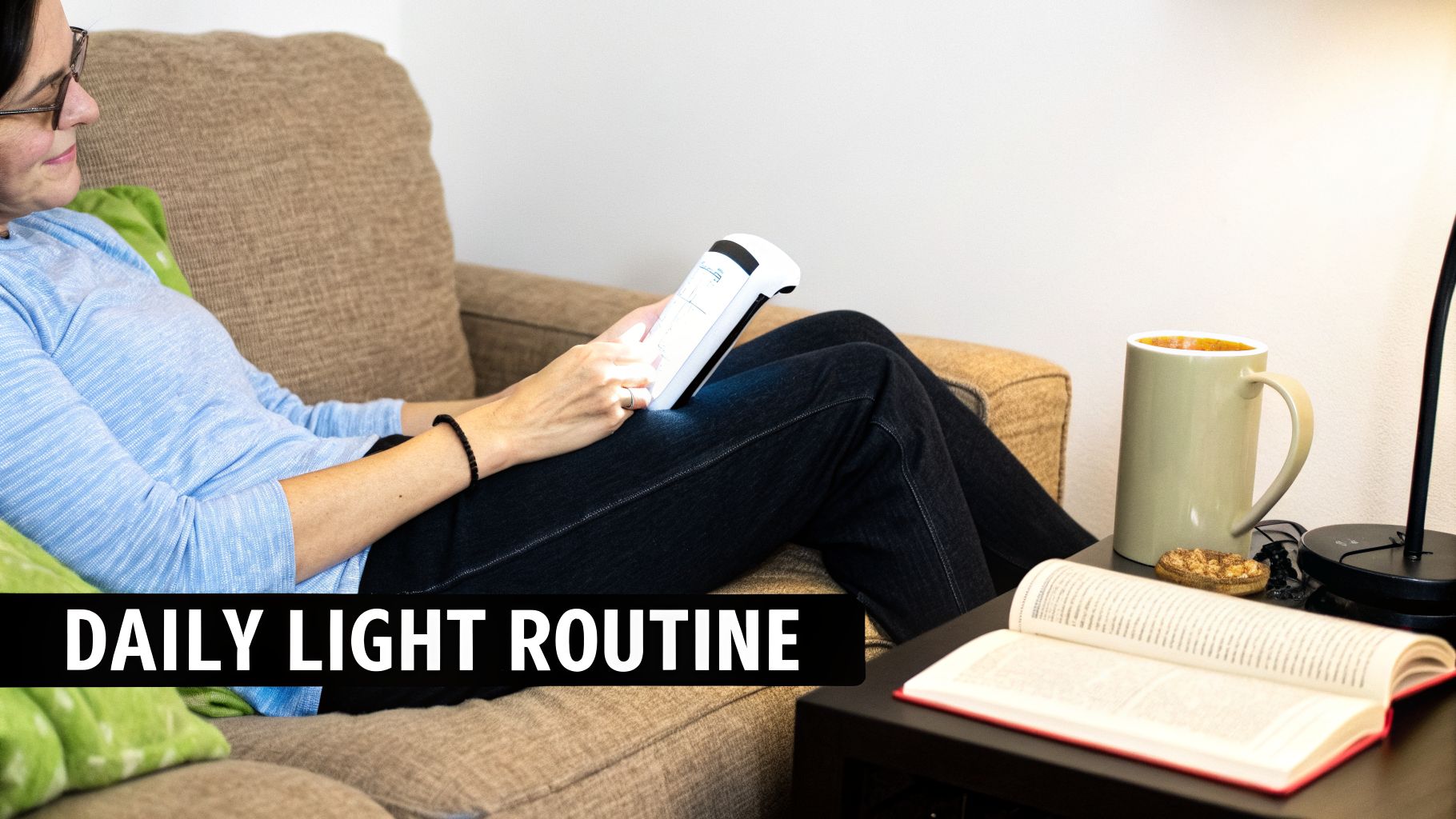
Bringing at-home LED therapy into your eczema care plan is all about giving you more control over your skin. Unlike clinical appointments that can be a hassle to schedule, the beauty of modern devices is how easily they can fit right into your life. The real secret to success with light therapy isn't about intensity; it's all about consistency.
Your goal is to build a routine that feels so natural it becomes second nature. Think of it less as a chore and more as a quiet moment of self-care. With the right approach, you can weave this gentle therapy into your daily rhythm, helping your skin become stronger and more resilient over time.
Finding Your Treatment Rhythm
Getting started with an at-home LED device is refreshingly simple. Most people find success with short, frequent sessions that are easy to stick with for the long haul.
Here’s a good starting point for building your own routine:
- How Often? Aim for 3 to 5 sessions per week. This regular exposure helps maintain a steady anti-inflammatory effect and keeps the cellular repair process going.
- How Long? Most sessions last between 10 to 20 minutes for each area you're treating. This is the sweet spot for delivering an effective dose of light without overdoing it.
- How to Prep? Always use your device on clean, dry skin. Any creams, lotions, or serums can act as a barrier, blocking the light from getting where it needs to go. Save them for after your session is finished.
This approach reflects how far we've come from ancient heliotherapy to today's targeted devices. It’s a shift seen in modern medicine, too. A 2023 global survey revealed that 25% of dermatologists now prescribe home phototherapy for eczema, a massive jump from just 5% in 2000. Patients are clearly on board, with 82% reporting satisfaction with the portability. It’s this progress that allows for targeted red (660 nm) and near-infrared (850 nm) light to deliver results, like the 58% reduction in redness seen in one 8-week study.
Practical Tips to Make It Stick
To get the best results from every session, you have to make it easy on yourself. The less friction there is, the more likely you are to keep it up.
Try these simple tips to weave LED therapy into your day:
- Habit Stack: Pair your session with something you already do every day. Use your device while you sip your morning coffee, listen to a podcast, or unwind with a book before bed.
- Create a "Home Base": Keep your device, charger, and anything else you need in one convenient spot. No more hunting around the house when it's time for a session.
- Go Hands-Free: If you can, choose a device that lets you multitask. This freedom makes it much easier to fit in a session while you answer emails or just relax.
Consistency over intensity is the golden rule. A 15-minute session five times a week is far more powerful than one long session whenever you remember. It’s the gentle, repeated exposure that helps calm your skin and build resilience.
Starting Slow and Listening to Your Skin
While red and near-infrared light therapy has a fantastic safety profile, it’s always smart to start slowly, especially with sensitive, eczema-prone skin. Pay close attention to how your body responds.
When you're first starting out, follow these simple safety steps:
- Start Short: Begin with sessions of just 5-10 minutes to let your skin acclimate.
- Watch and Learn: After each session, check the area for any unusual irritation. The goal is a gradual reduction in redness, not new sensitivity.
- Build Up Slowly: If your skin is happy, you can gradually increase your session time to the recommended 15-20 minutes over the next week or two.
This cautious start helps you build confidence and ensures the experience is soothing right from the beginning. By listening to your skin, you can create a routine that feels both comfortable and effective. For more detailed guidance, we've put together a comprehensive resource you can always refer to. Check out our guide on how to use red light therapy for more in-depth tips and best practices.
Answering Your Top Questions About Light Therapy for Eczema
It’s completely normal to have a few questions before trying something new for your skin. Making a smart, informed choice is the first step toward relief, so let’s clear up some of the most common things people wonder about when it comes to light therapy and eczema.
Is LED Light Therapy Safe for All Skin Types and Tones?
Yes, absolutely. One of the biggest advantages of red and near-infrared light is its fantastic safety profile for all skin tones. Unlike UV rays, these are gentle, non-damaging wavelengths of light. They don’t come with the risks of sunburn, accelerated aging, or long-term skin damage that are always a concern with ultraviolet light.
The whole approach is different. Instead of suppressing your immune system through controlled damage, LED therapy works by helping your skin’s own repair mechanisms get back on track. This makes it a very well-tolerated option for most people. That said, if your eczema is particularly severe or atypical, it’s always smart to have a quick chat with your dermatologist before starting any new routine.
How Long Until I See Results from At-Home LED Therapy?
When it comes to at-home light therapy, patience and consistency are everything. This isn't an overnight fix; it's a gradual healing process that works from the inside out. Some people feel a soothing effect and less itching within the first few weeks, but the more visible changes in redness and skin texture take a bit longer.
For most, real, noticeable improvements start to build between 4 to 12 weeks of consistent daily use. In that time, your cells are getting energized, inflammation is slowly dialing down, and your skin is rebuilding its natural barrier.
Think of it like nurturing a garden. You don't plant a seed and see a flower the next day. You give it consistent sunlight and water, and over time, it grows strong and healthy. At-home LED therapy is that steady "light" your skin needs to repair itself.
A great tip is to snap a quick photo once a week. It’s a fantastic way to track the subtle but steady progress you might not notice just looking in the mirror each day.
Can I Use Light Therapy with My Eczema Creams or Medications?
In most cases, yes. LED therapy fits beautifully alongside a good skincare routine and can complement your daily moisturizers and cleansers. The key, however, is all in the timing.
For the best results, you must use your LED device on clean, dry skin. This is non-negotiable. Thick creams, heavy ointments, and even some serums can create a barrier that reflects the light, preventing it from getting deep into your skin where it needs to work. Once your light session is done, feel free to apply all your favorite moisturizers to lock in hydration.
There is one major exception: if you’re using any prescription topicals or taking oral medications known to cause photosensitivity (making you more sensitive to light), you absolutely must talk to your doctor before starting light therapy. It’s a crucial step to avoid any unwanted reactions.
Will At-Home Light Therapy Cure My Eczema?
It's so important to go into this with the right mindset. At-home light therapy is a powerful tool for managing eczema, but it is not a cure. Eczema is a chronic condition, and right now, there's no way to get rid of it for good. The goal of any effective treatment is to manage symptoms, reduce flare-ups, and improve your quality of life.
This is where at-home LED therapy truly shines. By making it a regular part of your life, you can:
- Significantly cut down on the frequency and severity of your flare-ups.
- Calm the underlying inflammation that drives the redness and itching.
- Improve the overall health and resilience of your skin long-term.
It’s a proactive strategy that helps you gain more control, giving you longer stretches of clear, comfortable skin and keeping your eczema in a much calmer state.
Are LED Devices the Same as Clinical Phototherapy?
No, they aren’t, and this is a critical difference to understand. The phototherapy you’d get in a dermatologist's office almost always uses narrow-band ultraviolet B (UVB) light. It can be very effective for severe eczema, but it also carries the risks of UV radiation and has to be done under strict medical supervision.
At-home LED devices are completely different. They use zero UV light. Instead, they rely on specific, non-damaging wavelengths of red and near-infrared light. Their entire mechanism is different:
- UV Phototherapy: Works by suppressing the local immune system in your skin.
- LED Therapy: Works by giving your skin cells more energy and reducing inflammation to promote natural healing.
This fundamental difference is why LED therapy is safe for you to use at home without a prescription. It has become the go-to for anyone looking for a gentler, more accessible way to manage their skin. Our product is 100% LED-based, focusing entirely on this safe, regenerative approach.
Ready to take control of your skin's health with a convenient, modern solution? The Prospek therapy cap is designed for consistency and comfort, delivering targeted red and near-infrared light in a hands-free, portable design. Discover how Prospek can fit into your life and start your journey toward calmer skin today.