

Finding a new bald spot can be a shock. That moment in the mirror can send your mind racing, but what you do next is what truly matters. Before you can even think about regrowing hair, you have to play detective to figure out what’s happening on your scalp. This initial assessment is everything—it’s the foundation for any plan that has a real shot at working.
Your First Moves When You Spot Hair Loss
Seeing a thinning patch or a perfectly smooth spot for the first time is unnerving. The natural reaction is to panic, but I'm going to ask you to do the opposite: become a calm, careful observer. The goal right now isn't to land on a perfect diagnosis, but simply to gather the facts.
This initial information-gathering phase is what empowers you. It helps you understand whether this is something you can tackle with an at-home routine or if it’s time to bring in a professional for a more productive conversation.
This simple decision tree can help guide your immediate thoughts.
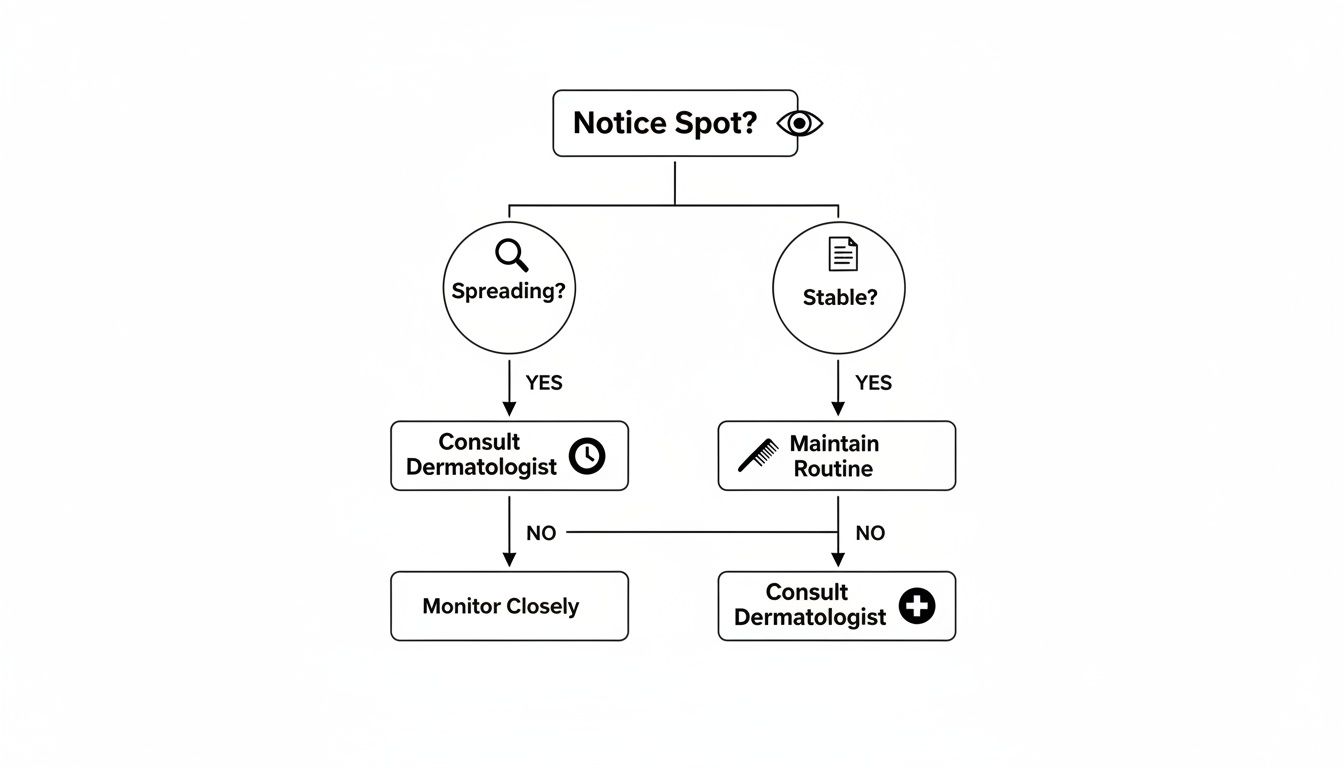
As the flowchart shows, one of the first things to figure out is whether the spot is stable or still spreading. This single detail can point you in very different directions.
Start by Documenting What You See
Before you buy any products or change your routine, you need to know what you’re up against. Different types of hair loss look and behave differently. So, grab your phone and take clear, well-lit photos of the area. Get pictures from a few different angles, and make a plan to do this once a week. This visual diary will be invaluable.
Next, take a closer look at the characteristics of the hair loss. Here's what you might be seeing:
- Androgenetic Alopecia (Pattern Baldness): This is the most common culprit. It’s usually a slow, gradual thinning process, often starting at the temples, the crown, or as a widening part line. Genetics and hormones are the primary drivers here.
- Alopecia Areata: This is an autoimmune condition that often shows up out of the blue. It typically creates one or more perfectly round, smooth, coin-sized bald spots that can appear anywhere on the scalp.
- Telogen Effluvium: This isn't about spots, but about massive, all-over shedding. You'll notice way more hair in your brush, on your pillow, or in the shower drain. It’s often triggered by a major physical or emotional stressor, like a serious illness, surgery, or a major life change.
- Traction Alopecia: This is hair loss caused by physical stress on the hair follicles. If you frequently wear tight braids, ponytails, or buns, you might see thinning along your hairline or in the specific areas pulled tightest.
Red Flags: When to See a Professional
While you can often get a head start at home, some signs are non-negotiable signals that you need a dermatologist. Trying to treat the wrong condition is a waste of time and money, and in some cases, it can let the problem get worse.
An accurate diagnosis is the single most important step. Trying to regrow hair without knowing the root cause is like navigating without a map—you're unlikely to reach your destination.
Book an appointment with a doctor or dermatologist if you experience any of these red flags:
- Sudden or Rapid Hair Loss: If you're losing a shocking amount of hair in a very short time.
- Distinct Bald Patches: Those smooth, circular patches are a classic sign of alopecia areata, which really needs a doctor's eye.
- Pain, Itching, or Flaking: If the hair loss comes with an irritated scalp, it could be a sign of a fungal infection or skin condition that needs medical treatment.
- Widespread, Heavy Shedding: If you're losing handfuls of hair every day, it’s crucial to see a doctor to rule out any underlying health problems.
By taking these first few steps, you shift from feeling anxious and helpless to being in control. You'll have the exact information you need to build a targeted, effective plan to get that hair back.
What's Really Happening on Your Scalp?

Before you can figure out how to regrow bald spots, you have to know what's going on under the surface. I like to think of hair follicles as tiny, independent engines. Each one runs on its own schedule, cycling through phases of growth and rest.
When your scalp is healthy and balanced, roughly 90% of your hair follicles are humming along in the anagen (growth) phase. During this period, which can last anywhere from two to eight years for a single hair, cells are rapidly dividing to build new hair fiber. Any number of disruptions can throw this delicate cycle out of whack, pushing follicles into a resting state far too early.
The Life Cycle of a Single Hair
Every single hair on your head goes through a continuous cycle. When that cycle gets interrupted, that's when you start seeing the tell-tale signs of thinning and patchiness.
Here's a quick look at the three main phases:
- Anagen (Growth Phase): This is the main event. It’s the active period where your follicles are working hard to produce hair. The longer a hair stays in the anagen phase, the longer it can grow.
- Catagen (Transition Phase): Think of this as a brief, two-week power-down. The follicle shrinks, cuts itself off from its blood supply, and stops growing.
- Telogen (Resting Phase): The follicle takes a break for about two to three months. At the end of this phase, the old hair sheds, and the follicle usually gets ready to start the anagen phase all over again.
The trouble starts when a large number of follicles are shoved into the telogen phase at the same time, or when the growth phase is cut short. This leads to that dreaded excessive shedding and keeps new hairs from growing in to take their place.
The Two Most Common Hair Loss Triggers
So, what causes this disruption? While there are many potential causes, two culprits are responsible for the vast majority of cases I see: hormones and stress.
For many men and women, the primary offender is a hormone called dihydrotestosterone (DHT). If you have a genetic predisposition to pattern baldness, DHT can attach to your hair follicles and cause them to shrink over time. This process, known as miniaturization, results in finer and shorter hairs with each cycle, until the follicle eventually gives up and stops producing hair altogether.
Stress is the other major player. A significant physical or emotional shock can trigger a condition called telogen effluvium, which literally jolts a huge number of your growing hairs straight into the resting phase. A few months down the line, you experience a sudden, and often alarming, wave of shedding.
Ultimately, regrowing hair comes down to one core principle: waking up dormant follicles and giving them the support they need to stay in the anagen (growth) phase longer. The goal is to give the follicles the energy and stimulation required to get back on track.
Reigniting Dormant Follicles
This is where modern, non-invasive approaches can make a real difference. If you want to know how to regrow bald spots, the answer often lies in stimulating cellular activity right at the root.
One of the most promising methods for this is LED therapy. Specific wavelengths of light, particularly red and near-infrared, can penetrate the scalp and energize the cells within your hair follicles. This gentle stimulation boosts circulation, calms inflammation, and ramps up the production of ATP—the fuel that powers all cellular activity, including hair growth. You can learn more about the specific mechanisms of LED light therapy in our detailed guide.
It's no surprise that the global hair restoration market is booming—it was valued at USD 6,463 million in 2023 and is projected to hit USD 18,923.4 million by 2030. This incredible growth is largely driven by androgenetic alopecia, the condition that affects over 95% of men experiencing hair loss. Better yet, studies have shown that consistent red light therapy can increase hair count by up to 35% after just 16 weeks, making it a powerful and convenient at-home solution. You can read the full research on hair restoration market trends.
Building Your Daily Hair Regrowth Ritual at Home
While prescriptions and procedures definitely have their place, the real, lasting progress in fighting hair loss often comes down to what you do at home. Every single day. A consistent routine sends a powerful signal to your scalp and follicles that it's time to get back into growth mode. The good news? It doesn’t have to be complicated. It just has to be consistent and built on strategies proven to support hair follicles.
At the heart of any modern, effective home routine is Low-Level Light Therapy (LLLT). This is a gentle, non-invasive method that essentially reawakens dormant hair follicles. By using specific wavelengths of light, it safely stimulates cellular activity right at the scalp level, making it a cornerstone practice if you’re serious about how to regrow bald spots.
The Power of LED Light Therapy
When you're looking into LLLT, today's advanced LED devices are an incredibly convenient and effective way to go. Unlike some other light therapy technologies, high-quality LEDs produce almost no heat, which means your sessions are comfortable and irritation-free. That comfort is key, because it makes it so much easier to stick with it day after day.
A device like the Prospek cap is built entirely around this principle. It uses a smart dual-spectrum approach that combines two of the most heavily researched wavelengths for maximum impact:
- Red Light (660nm): This wavelength is fantastic for working on the cells near the surface of your skin. It helps dial down inflammation—a major enemy of healthy hair follicles—and boosts circulation to bring in a fresh supply of oxygen and nutrients.
- Near-Infrared Light (850nm): This one goes deeper. Its main job is to fire up the production of adenosine triphosphate (ATP) inside your cells' mitochondria. Think of it as recharging the tiny batteries that power your hair follicles, giving them the raw energy needed to shift back into the growth phase.
The two lights work together beautifully. By calming the scalp environment while simultaneously energizing the follicles, you're tackling two of the biggest roadblocks to hair growth.
The secret weapon of an LED cap is how easily it fits into your actual life. A cordless, hands-free design means you can run a full 20-minute session while you're making coffee, checking emails, or just kicking back at the end of the day. This convenience makes all the difference in staying consistent enough to see real results.
Designing Your At-Home Hair Regrowth Plan
LED therapy is powerful, but it's even better when it’s part of a bigger plan. Think of it as the star player on your team—you still need a strong supporting cast. When you pair daily light sessions with other healthy habits, you create the best possible environment for hair regrowth.
To help you decide what's right for you, here’s a quick breakdown of common at-home treatments and how they fit into a routine.
Comparing At-Home Hair Regrowth Strategies
| Treatment | How It Works | Best For | Consistency Required | Key Benefit |
|---|---|---|---|---|
| LED Therapy Cap | Uses red/near-infrared light to reduce inflammation, boost circulation, and energize follicle cells (ATP). | Androgenetic alopecia and general thinning. | 3-5 times per week | Non-invasive, convenient, and targets cellular health. |
| Scalp Massage | Manually stimulates blood flow to the scalp, helping deliver more oxygen and nutrients to the follicles. | Anyone looking to enhance the effects of other treatments. | Daily (2-5 minutes) | Simple, free, and improves product absorption. |
| Supportive Shampoo | Cleanses the scalp of DHT, oil, and buildup without harsh sulfates that can cause irritation. | Oily or flaky scalps, and those using topical products. | As needed (2-4 times per week) | Creates a healthy scalp foundation for growth. |
Each of these strategies plays a distinct role, but they all work toward the same goal: a healthier scalp and stronger hair. For a full guide on getting started with your device, you can read our detailed instructions on how to use red light therapy effectively.
Creating Synergistic Habits
To really maximize what your LED therapy can do, a few simple habits can go a long way. They might not regrow hair on their own, but they create the perfect conditions for your main treatment to shine.
Incorporate Daily Scalp Massage Just a five-minute scalp massage can do wonders for circulation. Using the pads of your fingers—not your nails—apply firm but gentle pressure and move in small circles across your scalp. It feels incredible and reduces tension, but more importantly, it helps push more of that nutrient-rich blood directly to your hair follicles.
You can do this on a dry scalp anytime or use the time you're in the shower to really work in your shampoo. Consistency is everything here.
Choose the Right Shampoo Your shampoo has one critical job: clean your scalp without making things worse. So many shampoos on the shelf are loaded with harsh sulfates that strip your scalp of its natural oils, leaving it dry and irritated. That's the last thing you want.
When you're reading labels, look for shampoos that are:
- Sulfate-free: This is non-negotiable for avoiding irritation.
- Focused on scalp health: Some formulas include ingredients like saw palmetto or ketoconazole, which can help combat DHT and inflammation right at the source.
- Non-comedogenic: This just means it won't clog your pores or follicles.
When you combine consistent LED therapy with these simple, supportive habits, you build a powerful at-home ritual. This multi-angle approach gives you the best shot at waking up those dormant follicles and seeing the regrowth you're working toward.
When It's Time to Bring in Medical Treatments

While a solid at-home routine is the foundation of any good hair regrowth plan, there are times when it’s not quite enough on its own. If you’ve been consistent but your hair loss isn’t slowing down, or you’re just not seeing the progress you’d hoped for, it’s probably time to talk to a doctor or dermatologist.
This doesn't mean ditching what you're already doing. Think of it as adding a clinically proven powerhouse to your existing efforts. But first, you need a proper diagnosis. Trying to fix a hormonal issue with an anti-inflammatory cream is like trying to unlock a door with the wrong key—it just won’t work. Getting an accurate diagnosis ensures your efforts are targeted, effective, and most importantly, safe.
Topical Minoxidil
You’ve probably seen this one on the pharmacy shelves. Minoxidil is a very common over-the-counter topical that you apply right to your scalp. It’s a vasodilator, which is a technical way of saying it widens the blood vessels. This simple action boosts blood flow, oxygen, and nutrients to your hair follicles.
That extra circulation helps nudge more follicles into their active growth phase (the anagen phase) and keeps them there longer. It’s especially effective for androgenetic alopecia—what we commonly call pattern baldness—and can help slow loss and even regrow thicker hair.
The one catch with Minoxidil? You have to be religious about it. That means applying it once or twice a day, every single day. You’ll need to be patient, as it can take three to six months to see a noticeable difference. If you stop, any hair you’ve gained will likely fall out.
Oral Finasteride For Men
For men dealing with pattern baldness, oral Finasteride is a prescription-only option that tackles the problem at its hormonal source. It’s what’s known as a DHT blocker. It works by inhibiting the enzyme that converts testosterone into dihydrotestosterone (DHT)—the hormone that’s notorious for shrinking hair follicles.
By dramatically lowering DHT levels in the scalp, Finasteride can put the brakes on hair loss and, for many men, trigger significant regrowth. Because it’s a systemic medication, it’s only available by prescription and requires a doctor’s supervision to make sure it’s the right fit for you.
Critical Note: Finasteride is not approved for use in women of childbearing age due to the risk of birth defects. Your doctor is always the best person to guide you through prescription options safely.
Prescription Corticosteroids
Now, if your bald spots are caused by an inflammatory condition like alopecia areata, the game plan changes completely. Here, the enemy isn't DHT; it's your own immune system mistakenly attacking your hair follicles. The goal is to calm that inflammatory response.
Corticosteroids are powerful anti-inflammatory drugs that a doctor might prescribe in a few different ways:
- Topical Creams: You apply these directly to the bald patches to reduce inflammation locally.
- Injections: For a more potent and targeted approach, a dermatologist can inject corticosteroids right into the affected scalp areas.
- Oral Pills: These are typically reserved for more widespread or stubborn cases of inflammatory hair loss.
These treatments are only appropriate when inflammation is the root cause, which really drives home the point: you need a professional diagnosis before jumping into any medical regimen.
The demand for real solutions has pushed the industry forward. The hair growth serum market alone, which hit $1.84 billion in 2025, is on track to reach $2.69 billion by 2030. This boom is driven by more people looking for ways to strengthen their follicles. Interestingly, men—who experience alopecia at a 95% prevalence—are increasingly seeking out non-drug alternatives. This is where the science behind at-home devices gets exciting. Clinical evidence shows that 660 nm light can increase cellular energy (ATP), leading to 20-30% improvements in hair density over 12-24 weeks. It’s strong proof that devices like LED caps have a real, scientific place in a modern regrowth strategy. You can discover more insights about these hair care market trends if you want to dig into the data.
Tracking Your Progress and Setting Realistic Timelines
Let’s be honest: wanting to regrow hair is a long game. It’s a marathon, not a sprint. In my experience, the single biggest reason people fail is that they expect to see a full head of hair in a month and give up right before their treatment starts to work.
Staying motivated is half the battle. This starts with knowing what to expect and learning how to spot the small, early signs that things are moving in the right direction. Your hair follicles work on their own biological clock, and no treatment can speed that up overnight. You have to think in months, not weeks.
What Real Progress Actually Looks Like
The first hints of success are almost always quiet. Long before you see thick, new hair, you'll notice other positive changes. Learning to recognize these early wins is what will keep you going.
Here are the initial milestones to watch for:
- Less Shedding: This is often the very first sign that your routine is paying off. You’ll start to see less hair in your brush, on your pillow, or circling the shower drain. It means your follicles are getting stronger and holding onto hair for longer.
- "Peach Fuzz" Appears: Get up close to a mirror in good lighting and look at your target spots. You might see tiny, fine, light-colored hairs starting to emerge. This vellus hair is a fantastic signal that dormant follicles are waking up.
- A Calmer Scalp: You may also notice your scalp feels better—less itching, redness, or excessive oil. A healthy, balanced scalp is the perfect environment for new growth.
These subtle shifts usually start to show up within the first 3 to 6 months of consistent use. Don't dismiss them! These are proof that your daily efforts are making a real difference at a cellular level.
Patience is your most powerful tool when trying to regrow bald spots. Visible, meaningful changes in hair density realistically take at least six months to become apparent. Quitting too early is the most common mistake I see.
How to Document Your Hair Regrowth
To stay motivated, you need real proof that your efforts are working. Just "waiting and seeing" is a recipe for discouragement because day-to-day changes are too small to notice. The best approach is to get methodical.
A simple, consistent photo diary is the gold standard here.
Set yourself up for success by creating a simple routine. Find a spot in your home with bright, consistent lighting—near a window works best. Once a month, on the same day, snap a few photos from the same angles: front, top, and back of your head. Make sure to zoom in on the specific bald spots you're treating.
After three months, pull up your first set of photos next to your latest ones. This side-by-side comparison is where the magic happens. You’ll likely be shocked by the subtle but definite progress that you would have completely missed otherwise.
This visual evidence is what provides the motivation to stick with it. It’s where the science of consistency becomes crystal clear. For people with busy schedules, even 20-minute LED therapy sessions can create these measurable results. In some clinical trials, participants saw an increase of up to 51 hairs per square centimeter after 26 weeks of regular use.
The demand for effective, non-invasive solutions like this is booming. The global market for hair growth products hit USD 9.2 billion in 2025 and is projected to climb to USD 12.3 billion by 2034. You can explore more data on the growing demand for hair growth solutions to see just how big this field is becoming.
Pairing your photo tracking with a consistent treatment schedule is what truly drives results. For more practical advice on building that routine, check out our guide on how often you should use red light therapy.
Your Hair Regrowth Questions, Answered

Once you decide to tackle hair loss, a million questions can start running through your head. Is it too late? Will this even work for me? How long is this going to take? Getting straight answers helps you set realistic expectations and stick with a plan that actually gets results.
Let's clear up some of the most common questions we hear every day.
Can I Regrow Hair on Bald Spots That Are Years Old?
This is probably the most frequent question we get, and the honest answer is: it depends on the follicle.
Think of it this way: if a hair follicle is just "asleep" (dormant) but still alive, you absolutely have a chance to wake it up. Consistent treatment can bring these dormant follicles back online.
However, if a follicle has been dormant for many years, it can eventually scar over and die. This is common in the later stages of androgenetic alopecia or with scarring forms of hair loss. Once a follicle is gone, no treatment can bring it back.
The key takeaway is that starting early gives you the best odds. A consistent routine with a proven method like LED therapy can help revive dormant follicles before they become permanently inactive.
Treatments that boost circulation and give your cells an energy boost—like LED therapy or topical minoxidil—are your best shot at stimulating these sleeping follicles.
How Do I Know if LED Therapy Is Right for My Hair Loss?
LED light therapy, specifically using red and near-infrared wavelengths, is a game-changer for androgenetic alopecia—the classic pattern baldness that affects so many men and women. It gets right to the source by improving blood flow and stimulating cellular activity in the follicles.
Because it's non-invasive and has an excellent safety profile, it's a perfect starting point for many people. It also works well alongside other treatments you might already be using.
The main exception is hair loss from autoimmune conditions like alopecia areata, which causes those distinct smooth, round patches. If you see that, your first stop should be a dermatologist. They can give you a proper diagnosis and build a plan for that specific condition.
How Long Until I See Results From an LED Therapy Cap?
This is where patience becomes your superpower. Hair grows in slow, deliberate cycles, and there are no shortcuts. Consistency is everything.
Here’s a realistic timeline of what you can expect when you stick with your LED cap routine:
- 3 to 6 Months: You should start to see less shedding. Many people also notice the first signs of new growth—soft, fine "peach fuzz" hairs in the treatment areas.
- 6 to 12 Months: This is when you'll likely see more noticeable improvements in hair density and overall coverage. The new hairs start to mature and thicken.
- 12+ Months: Continued use is all about maintaining your gains and building on them for even better long-term results.
It's so important to stick with it. If you stop the treatments, the underlying circulatory and hormonal issues that caused the hair loss in the first place will return. Unfortunately, any new hair you've gained will likely be lost over the following months.
Are At-Home LED Therapy Devices Safe?
Yes, when you choose a high-quality device, LED therapy is one of the safest hair regrowth treatments you can do at home. It's a chemical-free, non-invasive method that simply supports your body's own natural ability to grow hair.
Unlike some other light treatments, LEDs produce almost no heat, making the sessions comfortable and irritation-free. For instance, the Prospek cap was designed with breathable materials and ventilation specifically to keep you from feeling any heat buildup during your 20-minute session.
This makes it a fantastic option for anyone who wants to avoid the potential systemic side effects that sometimes come with oral medications.
Ready to take control of your hair health with a convenient, effective, and safe at-home solution? The Prospek LED therapy cap is designed to fit seamlessly into your daily life, delivering powerful red and near-infrared light to energize your follicles. Discover how easy it is to build a consistent routine by visiting https://prospekthera.com.